
Problem 395 #6: Pyramid and Polynomial Function Construction
Loading the math board and drawing, please wait…
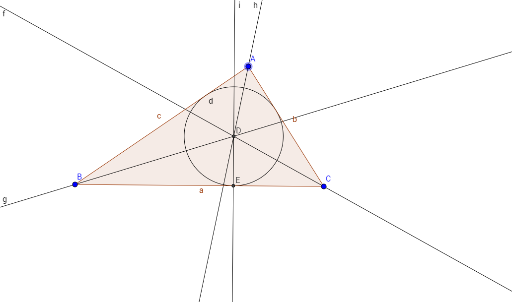
This example demonstrates a composite figure combining a pyramid (solid geometry) with polynomial function graphs, constructed using planar geometric tools to create a symmetric spatial structure. Core mathematical concepts include the relationship between the apex and base of a pyramid, intersections of lines and circles, angle bisectors, perpendicular lines, and the graphical features of polynomial functions. Construction highlights: using GeoGebra commands such as Polygon to create the base polygon poly1, AngularBisector for angle bisectors, Intersect to find intersection points, OrthogonalLine for perpendiculars, and Circle for auxiliary circles, resulting in points A, B, C, D, E and lines a, b, c, d, f, g, h, i that form the pyramid's edges and cross-sections. Suitable for high school or early college students to understand the integration of solid geometry and function graphs, and useful for math lab activities or competition training, providing an intuitive view of the interaction between spatial shapes and algebraic curves.
GeoGebra Commands & Parameters
Polygon(A, B, C) → poly1, c, a, bAngularBisector(A, C, B) → fAngularBisector(C, B, A) → gAngularBisector(B, A, C) → hIntersect(f, g) → DOrthogonalLine(D, a) → iIntersect(i, a) → ECircle(D, E) → d
AI Drawing Prompt Reference
Draw a triangular pyramid with a base triangle and an apex. The base triangle has three vertices positioned at left, right, and top. From each vertex, draw the angle bisector of the two adjacent sides; the three bisectors intersect at a point inside the triangle, which serves as the pyramid's apex. From this apex, drop a perpendicular line to one side of the base triangle, with the foot of the perpendicular lying on that side. Using the apex as the center and the distance from the apex to the foot as the radius, draw an auxiliary circle. The overall figure should clearly show the pyramid's edges, the angle bisectors, the perpendicular line, and the auxiliary circle, maintaining symmetry and clarity.
The prompt above was compiled from the original drawing commands and is for reference only.