
Probability of Rain Drops Falling into a Circular Bucket
Loading the math board and drawing, please wait…
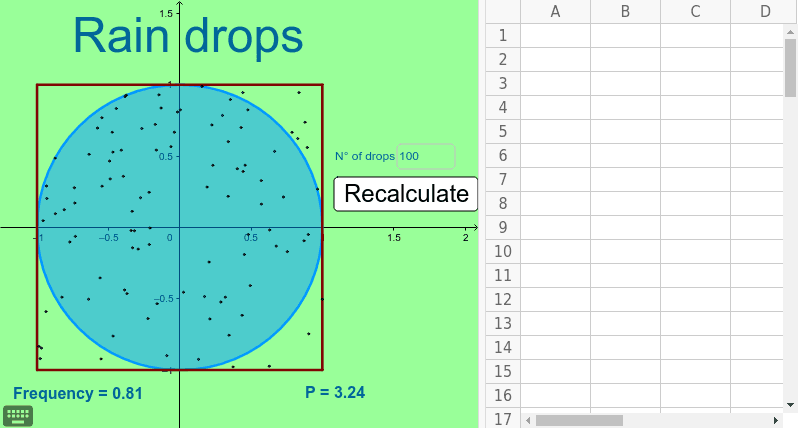
This applet simulates the probability of rain drops falling into a circular bucket inside a square container. It involves core concepts of probability and statistics. Using GeoGebra commands such as Segment, Intersect, Circle, etc., a dynamic rain drop simulation is constructed. Suitable for middle school and above students to learn probability and geometric construction.
GeoGebra Commands & Parameters
Segment(D, C) → aSegment(C, B) → bSegment(B, A) → cSegment(A, D) → dIntersect(xAxis, yAxis) → OCircle(O, 1) → eSequence((Random[-1000, 1000] / 1000, Random[-1000, 1000] / 1000), n, 1, N) → GSequence(If[Distance[Element[G, n], O] ≤ 1, 1, 0], n, 1, N) → STextfield(N) → campoInserimento1
AI Drawing Prompt Reference
Draw a square container with a circular bucket inside. Simulate the probability of raindrops falling into the circular bucket. First, draw the four sides of the square, then draw a circle centered at the square's center with a radius equal to half the side length of the square. Next, randomly generate some points to represent raindrops and check if they fall inside the circle, counting the number of raindrops that land inside.
The prompt above was compiled from the original drawing commands and is for reference only.