
Practice: Quadratic Equations with Irrational Solutions
Loading the math board and drawing, please wait…
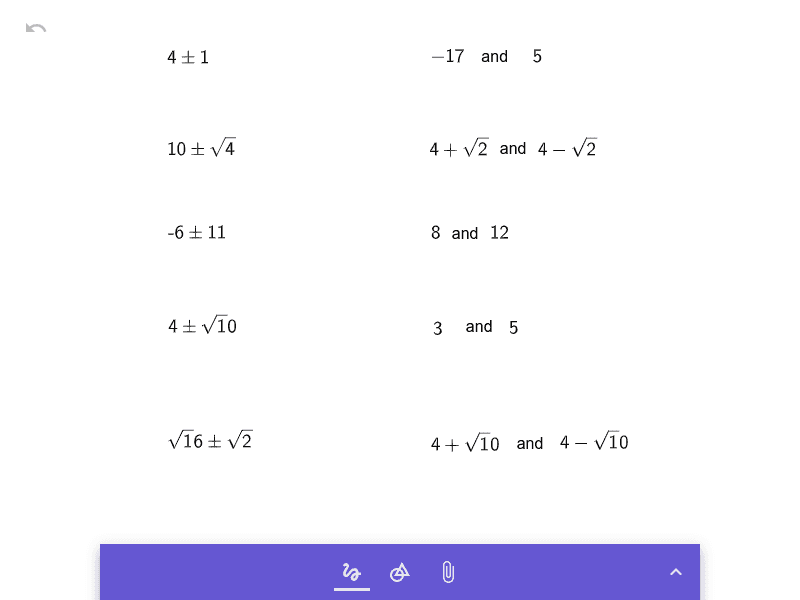
This GeoGebra practice example illustrates quadratic equations whose solutions are irrational numbers, focusing on the case where the discriminant is positive but not a perfect square. It demonstrates the connection between the quadratic formula, the parabolic graph, and the x-intercepts that are irrational numbers. Interactive features include coefficient sliders for real-time parameter adjustment, dynamic discriminant calculation, and movable root markers on the coordinate plane. The example helps learners visualize how irrational solutions appear geometrically and understand the relationship between algebraic structure and graphical behavior. It is suitable for high school algebra courses, reinforcing concepts of real numbers, quadratic functions, and graphical analysis of equations.
AI Drawing Prompt Reference
Draw a Cartesian coordinate system with an upward-opening parabola representing the quadratic function y = x² + 2x - 1. The parabola should intersect the x-axis at two points with irrational number coordinates, specifically at x = -1 + √2 and x = -1 - √2. Include the coordinate axes and grid lines, mark the vertex of the parabola at (-1, -2). Show two distinct points on the x-axis representing these irrational roots, with their exact expressions displayed nearby. Also display the discriminant calculation D = b² - 4ac = 8 to illustrate that since D > 0 but is not a perfect square, the equation has two irrational solutions.
The prompt above was compiled from the original drawing commands and is for reference only.