
Practice: Evaluating Logarithmic Expressions Using Key Log Laws
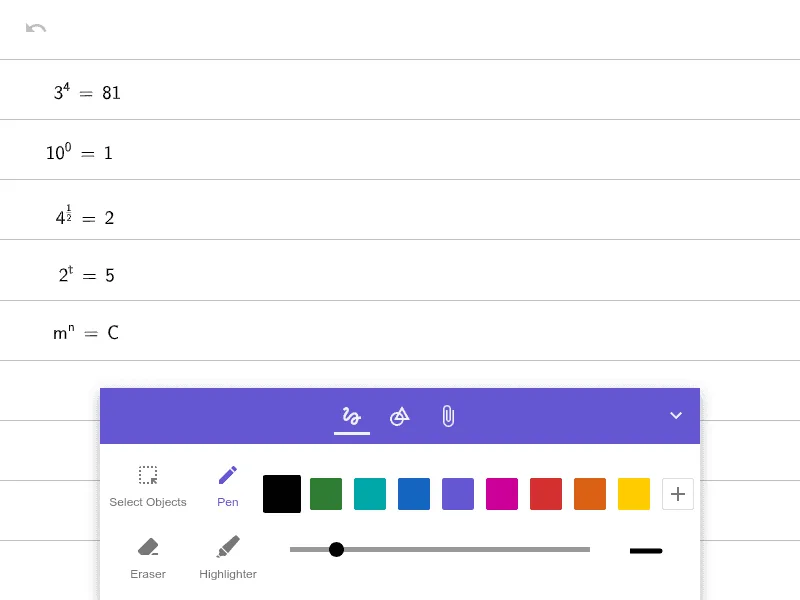
Loading the math board and drawing, please wait…
This example demonstrates how to evaluate given logarithmic expressions through systematic simplification. It focuses on core ideas such as the definition of logarithms, the product and power rules (log_a(xy)=log_a x+log_a y and log_a(x^k)=k·log_a x), and using valid parameter constraints to keep the logarithms defined (e.g., a>0, a≠1, and the argument >0). In GeoGebra, the construction is typically set up by defining the parameters (base and variables), then entering the logarithmic expression directly and/or representing it via log functions so that the expression can be computed and checked. Since no GeoGebra construction commands are provided in the supplied construction summary, the emphasis is on correctly modeling the expression and ensuring domain validity. Suitable for late secondary school through early college students studying algebra and functions, and useful for practice, homework, and instruction on logarithmic computation techniques.
AI Drawing Prompt Reference
Draw a diagram illustrating the evaluation of logarithmic expressions, focusing on key properties such as the product rule and power rule. Include logarithmic functions, parameters like base and variables, and the original expressions. Ensure all objects meet the conditions for logarithmic validity: base > 0 and base ≠ 1, and argument > 0. The construction order should be: first define parameters, then draw logarithmic functions, and finally show simplified expressions.
The prompt above was compiled from the original drawing commands and is for reference only.