
Phantom Graph - Devil's Curve
Loading the math board and drawing, please wait…
In collections
Phantom Graphs
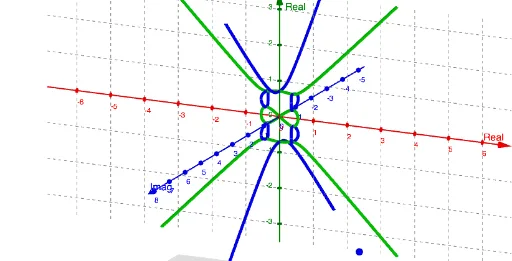
This example demonstrates the Devil's Curve, a special type of curve with the equation (x^2+y^2-1)^3-x^2y^3=0. Using GeoGebra commands such as Plane, ComplexRoot, and CurveCartesian, this curve can be constructed. Suitable for high school mathematics education and learning coordinate geometry.
GeoGebra Commands & Parameters
Plane((0, c, 0), (1, c, 0), (0, c, 1)) → pComplexRoot(c^(4) - x^(4) + (a * c^(2)) + (b * x^(2))) → z_1, z_2, z_3, z_4CurveCartesian(0, sqrt(((-a) + sqrt(a^(2) + ((4 * b) * t^(2)) + (4 * t^(4)))) / 2), t, t, -50, 50) → eCurveCartesian(0, (-sqrt(((-a) + sqrt(a^(2) + ((4 * b) * t^(2)) + (4 * t^(4)))) / 2)), t, t, -50, 50) → fCurveCartesian(t, sqrt(((-a) + sqrt((-16 * t^(4)) + ((8 * b) * t^(2)) + a^(2) - b^(2))) / 2), sqrt(t^(2) - b / 2), t, -100, 100) → hCurveCartesian(t, sqrt(((-a) - sqrt((-16 * t^(4)) + ((8 * b) * t^(2)) + a^(2) - b^(2))) / 2), sqrt(t^(2) - b / 2), t, -100, 100) → iCurveCartesian(t, sqrt(((-a) + sqrt((-16 * t^(4)) + ((8 * b) * t^(2)) + a^(2) - b^(2))) / 2), (-sqrt(t^(2) - b / 2)), t, -100, 100) → lCurveCartesian(t, sqrt(((-a) - sqrt((-16 * t^(4)) + ((8 * b) * t^(2)) + a^(2) - b^(2))) / 2), (-sqrt(t^(2) - b / 2)), t, -100, 100) → mCurveCartesian(t, (-sqrt(((-a) + sqrt((-16 * t^(4)) + ((8 * b) * t^(2)) + a^(2) - b^(2))) / 2)), sqrt(t^(2) - b / 2), t, -100, 100) → nCurveCartesian(t, (-sqrt(((-a) + sqrt((-16 * t^(4)) + ((8 * b) * t^(2)) + a^(2) - b^(2))) / 2)), (-sqrt(t^(2) - b / 2)), t, -100, 100) → oCurveCartesian(t, (-sqrt(((-a) - sqrt((-16 * t^(4)) + ((8 * b) * t^(2)) + a^(2) - b^(2))) / 2)), sqrt(t^(2) - b / 2), t, -100, 100) → qCurveCartesian(t, (-sqrt(((-a) - sqrt((-16 * t^(4)) + ((8 * b) * t^(2)) + a^(2) - b^(2))) / 2)), (-sqrt(t^(2) - b / 2)), t, -100, 100) → j
AI Drawing Prompt Reference
Draw the Devil's Curve defined by the equation (x^2+y^2-1)^3-x^2y^3=0. Start by drawing a plane, then use parametric equations to plot the curve, which consists of four main parts representing the four branches of the curve.
The prompt above was compiled from the original drawing commands and is for reference only.