
Pentagonal Net with Double Ellipses and Open Spheres
Loading the math board and drawing, please wait…
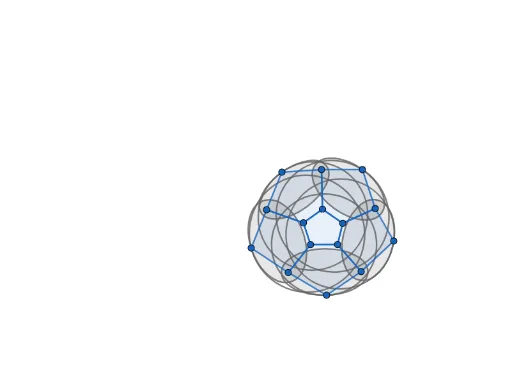
① This example demonstrates a complex 3D geometric construction combining a pentagonal net with double ellipses and open spheres, illustrating the interweaving of polygons and conic sections in space. ② Core mathematical concepts include polygons (pentagons), ellipses as conic curves, spheres as 3D surfaces, and their symmetric/nested arrangements, bridging solid geometry and coordinate geometry. ③ Construction highlights: from the summary, the GeoGebra commands used are Polygon (creating poly1 to poly5) and Ellipse (creating ellipses a, b, c, d, e), with points A–N and segments (a_1, b_1, etc.) connecting to form the net, and open spheres added as surface elements. ④ Suitable for high school or college-level solid geometry and analytic geometry classes, as well as mathematical art or 3D modeling projects, helping students understand spatial combinations of polygonal meshes, conic sections, and spheres.
GeoGebra Commands & Parameters
Polygon(A, B, C, D, E) → poly1, a, b, c, d, ePolygon(A, B, F, G, H) → poly2, a_1, b_1, f, g, hPolygon(B, C, I, J, F) → poly3, b_2, c_1, i, j, f_1Polygon(C, D, K, L, I) → poly4, c_2, d_1, k, l, i_1Polygon(D, E, M, N, K) → poly5, d_2, e_1, m, n, k_1Polygon(E, A, H, O, M) → poly6, e_2, a_2, h_1, o, m_1Ellipse(M, K, N) → pEllipse(E, D, N) → qEllipse(K, I, L) → rEllipse(D, C, L) → sEllipse(C, B, J) → tEllipse(I, F, J) → g_1Ellipse(B, A, G) → p_1Ellipse(F, H, G) → q_1Ellipse(A, E, O) → r_1Ellipse(H, M, O) → s_1Polygon(A_1, B_1, C_1, D_1, E_1) → poly1_1, a_3, b_3, c_3, d_3, e_3Polygon(A_1, B_1, F_1, G_1, H_1) → poly2_1, a_4, b_4, f_2, g_3, h_2Polygon(B_1, C_1, I_1, J_1, F_1) → poly3_1, b_5, c_4, i_2, j_1, f_3Polygon(C_1, D_1, K_1, L_1, I_1) → poly4_1, c_5, d_4, k_2, l_1, i_3Polygon(D_1, E_1, M_1, N_1, K_1) → poly5_1, d_5, e_4, m_2, n_1, k_3Polygon(E_1, A_1, H_1, O_1, M_1) → poly6_1, e_5, a_5, h_3, o_1, m_3Ellipse(M_1, K_1, N_1) → p_2Ellipse(E_1, D_1, N_1) → q_2Ellipse(K_1, I_1, L_1) → r_2Ellipse(D_1, C_1, L_1) → s_2Ellipse(C_1, B_1, J_1) → t_1Ellipse(I_1, F_1, J_1) → g_2Ellipse(B_1, A_1, G_1) → p_3Ellipse(F_1, H_1, G_1) → q_3Ellipse(A_1, E_1, O_1) → r_3Ellipse(H_1, M_1, O_1) → s_3Polygon(A_2, B_2, C_2, D_2, E_2) → poly1_2, a_6, b_6, c_6, d_6, e_6Polygon(A_2, B_2, F_2, G_2, H_2) → poly2_2, a_7, b_7, f_4, g_5, h_4Polygon(B_2, C_2, I_2, J_2, F_2) → poly3_2, b_8, c_7, i_4, j_2, f_5Polygon(C_2, D_2, K_2, L_2, I_2) → poly4_2, c_8, d_7, k_4, l_2, i_5Polygon(D_2, E_2, M_2, N_2, K_2) → poly5_2, d_8, e_7, m_4, n_2, k_5Polygon(E_2, A_2, H_2, O_2, M_2) → poly6_2, e_8, a_8, h_5, o_2, m_5Ellipse(M_2, K_2, N_2) → p_4Ellipse(E_2, D_2, N_2) → q_4Ellipse(K_2, I_2, L_2) → r_4Ellipse(D_2, C_2, L_2) → s_4Ellipse(C_2, B_2, J_2) → t_2Ellipse(I_2, F_2, J_2) → g_4Ellipse(B_2, A_2, G_2) → p_5Ellipse(F_2, H_2, G_2) → q_5Ellipse(A_2, E_2, O_2) → r_5Ellipse(H_2, M_2, O_2) → s_5
AI Drawing Prompt Reference
Create a 3D geometric structure composed of three nested layers of pentagonal nets, each layer consisting of six pentagonal faces connected by shared edges, resembling an unfolded polyhedral mesh. Within or along each pentagon, embed pairs of intersecting ellipses whose endpoints are the pentagon vertices, forming symmetric curved crossing patterns. Add open spherical surfaces distributed in space, interweaving with the polygons and ellipses to enhance depth and visual complexity. The overall composition should exhibit symmetry and nested elegance, suitable for mathematical art or spatial geometry modeling.
The prompt above was compiled from the original drawing commands and is for reference only.