
Pascal's Theorem (Hyperbola)
Loading the math board and drawing, please wait…
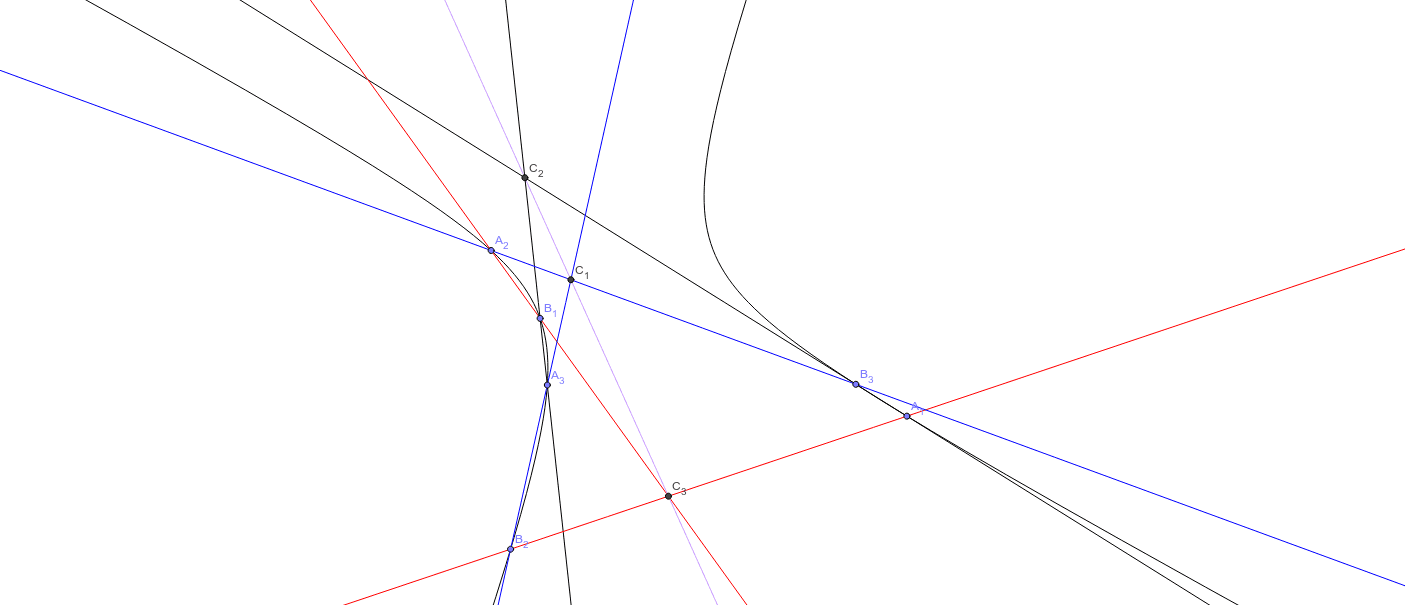
This example demonstrates Pascal's Theorem on a hyperbola, showcasing the collinearity of six points. Key math concepts include hyperbolas, straight lines, and concurrent intersections. Construction involves commands like Hyperbola, Point, Line, and Intersect to create points, lines, and intersection points. Suitable for high school and above students learning analytical geometry and theorem applications.
GeoGebra Commands & Parameters
Hyperbola(A, B, C) → cPoint(c) → A_2Point(c) → A_3Point(c) → A_1Point(c) → B_1Point(c) → B_2Point(c) → B_3Line(B_1, A_3) → aLine(B_3, A_1) → bIntersect(a, b) → C_2Line(A_2, B_1) → dLine(B_2, A_1) → ePoint(d) → DIntersect(d, e) → C_3Line(A_2, B_3) → fLine(B_2, A_3) → gIntersect(f, g) → C_1Line(C_1, C_3) → h
AI Drawing Prompt Reference
Draw a hyperbola and place six points on it, grouped into three pairs. Connect one point from the first pair to one from the second pair, forming two lines whose intersection is a new point. Similarly, use the other pairs to create two more lines and their intersection. Then connect the remaining point pairs to get a third intersection. Finally, draw a line through these three intersection points to show they are collinear, illustrating Pascal's theorem on the hyperbola.
The prompt above was compiled from the original drawing commands and is for reference only.