
Parallelogram Examples and Non-examples
Loading the math board and drawing, please wait…
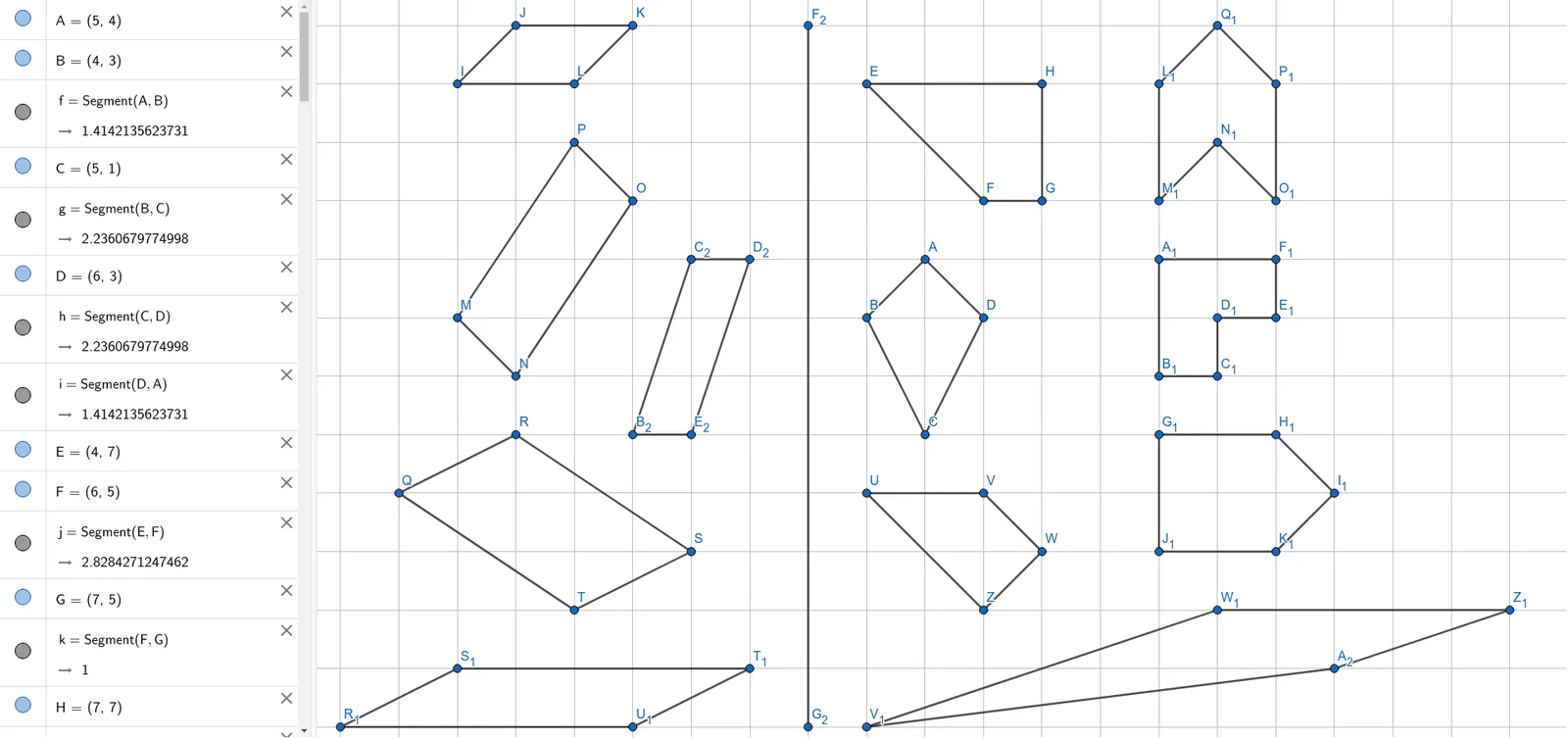
This example dynamically demonstrates the definition and properties of parallelograms, highlighting their differences from general quadrilaterals. Key math concepts include parallel lines, equal opposite sides, and bisecting diagonals. Construction involves commands like Segment to create points A, B, C, D, E, F, G, H, I, J, K, L, M, N, O, P, Q, R, S, T, and drawing segments and shapes. Suitable for middle school students and above to understand geometric properties and criteria for parallelograms.
GeoGebra Commands & Parameters
Segment(A, B) → fSegment(B, C) → gSegment(C, D) → hSegment(D, A) → iSegment(E, F) → jSegment(F, G) → kSegment(G, H) → lSegment(H, E) → mSegment(I, J) → nSegment(J, K) → pSegment(K, L) → qSegment(L, I) → rSegment(M, N) → sSegment(N, O) → tSegment(O, P) → aSegment(P, M) → bSegment(Q, R) → cSegment(R, S) → dSegment(S, T) → eSegment(T, Q) → f_1Segment(U, V) → g_1Segment(V, W) → h_1Segment(W, Z) → i_1Segment(Z, U) → j_1Segment(A_1, B_1) → k_1Segment(B_1, C_1) → l_1Segment(C_1, D_1) → m_1Segment(D_1, E_1) → n_1Segment(E_1, F_1) → p_1Segment(F_1, A_1) → q_1Segment(G_1, H_1) → r_1Segment(H_1, I_1) → s_1Segment(G_1, J_1) → t_1Segment(J_1, K_1) → a_1Segment(K_1, I_1) → b_1Segment(L_1, M_1) → c_1Segment(M_1, N_1) → d_1Segment(N_1, O_1) → e_1Segment(O_1, P_1) → f_2Segment(P_1, Q_1) → g_2Segment(Q_1, L_1) → h_2Segment(R_1, S_1) → i_2Segment(S_1, T_1) → j_2Segment(T_1, U_1) → k_2Segment(U_1, R_1) → l_2Segment(V_1, W_1) → m_2Segment(W_1, Z_1) → n_2Segment(Z_1, A_2) → p_2Segment(A_2, V_1) → q_2Segment(B_2, C_2) → r_2Segment(C_2, D_2) → s_2Segment(D_2, E_2) → t_2Segment(E_2, B_2) → a_2Segment(F_2, G_2) → b_2
AI Drawing Prompt Reference
Draw a parallelogram and a non-parallelogram to highlight their differences. The parallelogram should have two pairs of parallel and equal opposite sides with diagonals that bisect each other. The non-parallelogram should lack these properties. Start by drawing the four sides of the parallelogram, then the diagonals, and then draw the four sides of the non-parallelogram, followed by its diagonals, to emphasize the contrast between the two shapes.
The prompt above was compiled from the original drawing commands and is for reference only.