
Parallelogram and Rhombus: Incircle, Pythagorean Theorem, and Inequalities
Loading the math board and drawing, please wait…
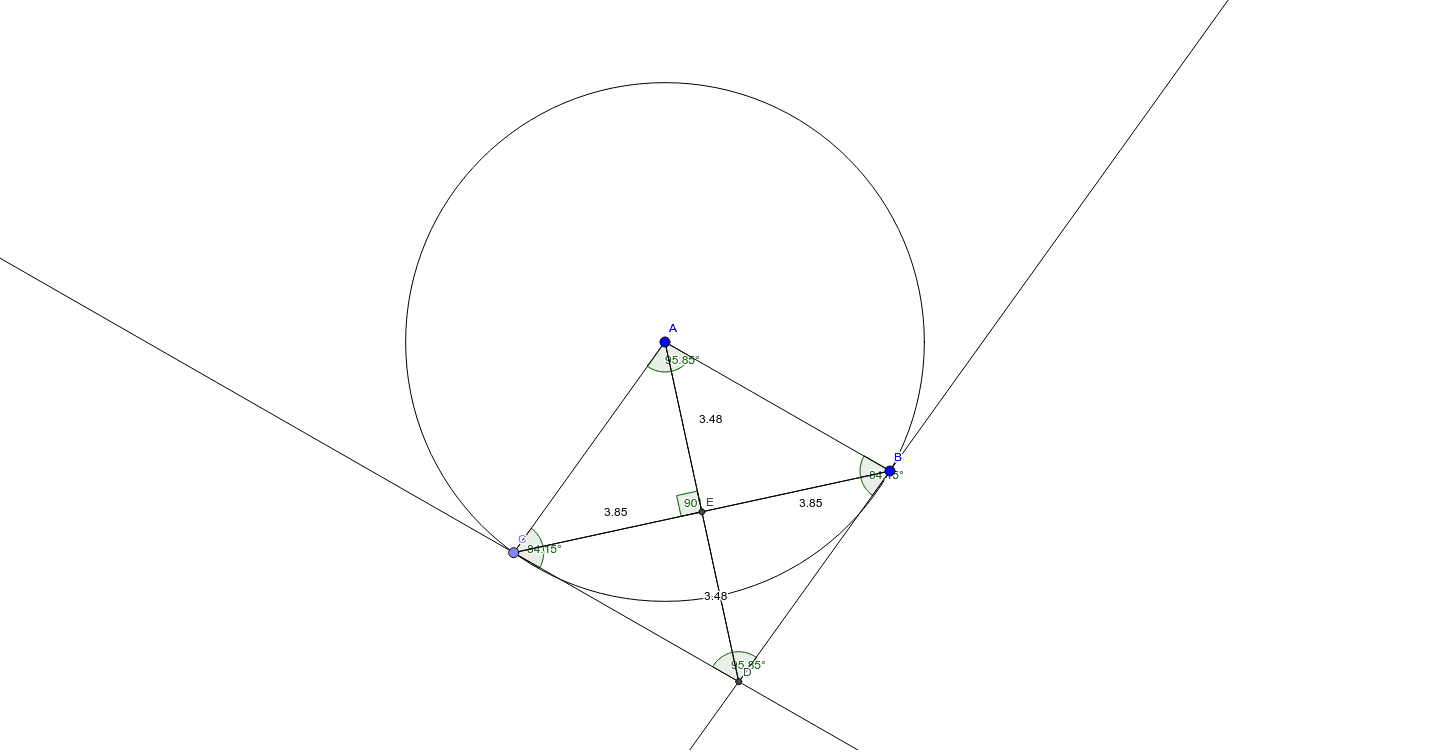
This GeoGebra example dynamically illustrates the geometric relationship between a parallelogram and a rhombus, focusing on the existence of an incircle in the rhombus and the application of the Pythagorean theorem to side-length relations. Core mathematical concepts include properties of parallelograms, perpendicular bisecting diagonals of a rhombus, the incircle's relation to side lengths and angles, and inequalities derived from geometric constraints. The construction uses commands such as Circle, Point, Segment, Line, Intersect, and Angle, involving objects like vertices A, B, C, D, sides a, b, c, d, diagonals e, f, and angles α, β, γ, δ, with linear regression to explore numerical patterns between sides and angles. This resource is suitable for middle and high school geometry classes, helping students visualize special quadrilateral properties, verify the Pythagorean theorem, and understand inequalities in geometric contexts. It also serves as a dynamic tool for inquiry-based learning and mathematical experimentation.
GeoGebra Commands & Parameters
Circle(A, B) → cPoint(c) → CSegment(A, C) → aSegment(A, B) → bLine(C, b) → dLine(B, a) → eIntersect(d, e) → DAngle(A, B, D) → αAngle(B, D, C) → βAngle(C, A, B) → γAngle(D, C, A) → δSegment(A, D) → fSegment(C, B) → gIntersect(f, g) → ESegment(E, B) → hSegment(E, A) → iSegment(E, D) → jSegment(E, C) → kAngle(A, E, C) → ε
AI Drawing Prompt Reference
Start with a circle and mark a point on it. Draw two radii from the center, one to the point and another to a second point on the circlecars. Through the first point, draw a line parallel to the second radius; through the center, draw a line parallel to the first radius. These two lines intersect to form the fourth vertex of a parallelogram. Then draw the two diagonals of this parallelogram and mark their intersection. From this intersection, draw segments to all four vertices. Finally, label the four interior angles and the angle between the diagonals. The figure shows a parallelogram inscribed in a circle, with perpendicular diagonals, and side lengths related by the Pythagorean theorem.
The prompt above was compiled from the original drawing commands and is for reference only.