
Parallelepiped with Triangular Base Derivative Applications
Loading the math board and drawing, please wait…
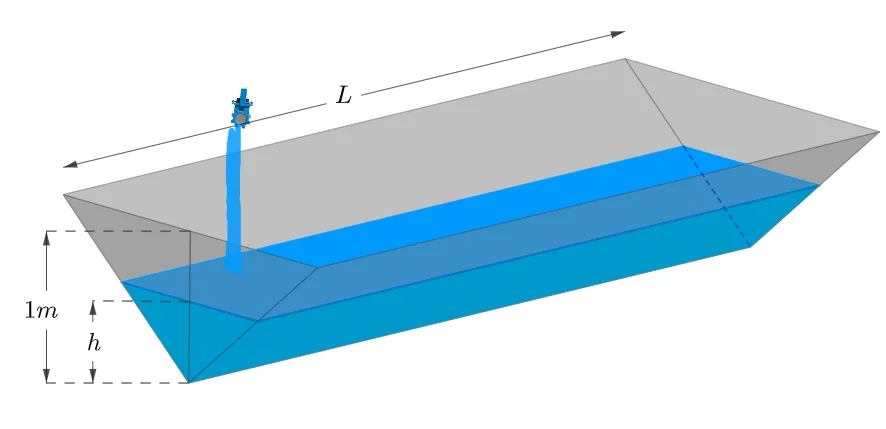
This example demonstrates a parallelepiped with a triangular base and its derivative applications. Key mathematical concepts include derivatives, power functions, and step functions. Construction involves using GeoGebra commands like Point, Midpoint, Segment, Line to create the triangular base, parallelepiped, and related functions. Suitable for high school students learning calculus fundamentals and geometric construction, useful for mathematical modeling and optimization problems.
GeoGebra Commands & Parameters
Point(yAxis) → AMidpoint(A, B) → G_1Segment(A, B) → fSegment(C, B) → gLine(C, f) → hLine(A, g) → iPoint(xAxis) → DSegment(D, A) → jSegment(D, B) → kLine(D, g) → lLine(C, k) → mIntersect(i, h) → EIntersect(l, m) → FSegment(F, E) → nSegment(A, E) → pSegment(C, E) → qSegment(C, F) → rSegment(F, D) → sPoint(n) → GLine(G, p) → tLine(G, q) → eIntersect(t, j) → ILine(I, f) → g_1Intersect(g_1, k) → JSegment(I, J) → h_1Segment(I, G) → j_1Intersect(e, m) → HSegment(J, H) → aSegment(G, H) → bPolygon(E, A, D, F, C) → polígono1, e_1, a_1, d, f_1, cPolygon(G, I, J, H) → c1, g_2, i_1, j_2, h_2Polygon(A, D, F, C, B) → polígono2, a_2, d_1, f_2, c_1, b_1Polygon(I, D, F, H, J) → polígono3, i_2, d_2, f_3, h_3, j_3Segment(E, G) → k_1Segment(G, F) → l_1Polygon(Q, R, S, T) → c2, q_1, r_1, s_1, t_1Line(V, xAxis) → m_1Line(U, xAxis) → n_1Point(m_1) → WOrthogonalLine(W, n_1) → p_1Intersect(p_1, n_1) → ZVector(W, Z) → uVector(Z, W) → vSegment(W, V) → k_2Segment(U, Z) → l_2Segment(V, U) → m_2Intersect(m_2, h_1) → A_1OrthogonalLine(A_1, m_2) → n_2Point(n_2) → B_1OrthogonalLine(B_1, l_2) → p_2Intersect(l_2, p_2) → C_1Intersect(h_1, i_1) → D_1Segment(A_1, B_1) → q_2Vector(B_1, C_1) → wVector(C_1, B_1) → u_1OrthogonalLine(A, k_2) → r_2Point(r_2) → E_1Line(E_1, p) → s_2Line(E, r_2) → t_2Intersect(s_2, t_2) → F_1Vector(E_1, F_1) → v_1Vector(F_1, E_1) → w_1Midpoint(B_1, C_1) → M
AI Drawing Prompt Reference
Draw a three-dimensional geometric model of a parallelepiped with a triangular base, where the base is a triangle and extends vertically to form a parallelepiped structure. The diagram should include multiple interconnected polygonal faces, showing the spatial relationship between the triangular base and the parallelogram lateral faces. Construct by drawing x-axis and y-axis, determining key points on the coordinate axes, connecting these points to form the three edges of the triangular base, then extending upward from the base to create the edges of the parallelepiped. Additionally, include function graph curves at appropriate positions in the figure to symbolize derivative applications, which may include power function curves and step function representations. The entire graphic should reflect the combination of geometric construction and function analysis, suitable for calculus beginners to understand the relationship between derivatives and geometry.
The prompt above was compiled from the original drawing commands and is for reference only.