
Parallel Lines and Transversals Theorem Demo
Loading the math board and drawing, please wait…
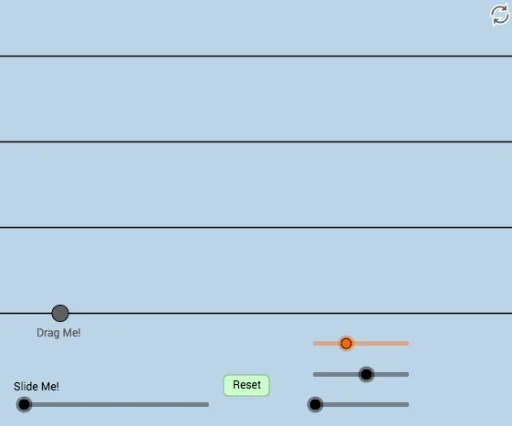
This example demonstrates the theorem stating that if parallel lines cut off congruent segments on one transversal, they cut off congruent segments on every transversal. It involves core math concepts like parallel lines, transversals, congruent segments, and geometric proofs. The construction uses commands such as Point, Line, Rotate, Angle, Ray, Circle, OrthogonalLine, Intersect, Segment, CircleSector, Dilate, Vector, and Translate. Suitable for high school geometry teaching to visually aid students in understanding the theorem.
GeoGebra Commands & Parameters
Point(y = 0) → ALine(A, B) → fRotate(B, α, A) → B'Angle(B, A, B') → βLine(A, B') → gRotate(B', γ, A) → B''Angle(B', A, B'') → δRay(A, B'') → hCircle(A, a) → cOrthogonalLine(A, g) → iIntersect(c, i, 2) → CCircle(C, a) → dIntersect(d, i, 2) → DCircle(D, a) → eIntersect(e, i, 2) → ELine(C, g) → jLine(D, g) → kLine(E, g) → lIntersect(h, j) → FIntersect(k, h) → GIntersect(l, h) → HSegment(A, F) → mCircle(A, (0.3 * m)) → pPoint(l) → IPoint(g) → JSegment(I, J) → nIntersect(k, n) → KIntersect(j, n) → LIntersect(p, g, 2) → MIntersect(p, h, 1) → NCircleSector(A, M, N) → qDilate(A, If[0 < b ≤ 1, 1 - b, 0], F) → A'Segment(A, A') → rDilate(F, If[1 < b ≤ 2, 2 - b, 0], G) → F'Segment(F, F') → sDilate(G, If[2 < b ≤ 3, 3 - b, 0], H) → G'Segment(G, G') → tDilate(A, If[3 < b ≤ 4, 4 - b, 0], F) → A'_1Vector(A, A'_1) → uTranslate(q, u) → q'Dilate(F, If[4 < b ≤ 5, 5 - b, 0], G) → F'_1Vector(F, F'_1) → vTranslate(q', v) → q''Dilate(G, If[5 < b ≤ 6, 6 - b, 0], H) → G'_1Vector(G, G'_1) → wTranslate(q'', w) → q'''Rotate(q''', If[6 < b ≤ 7, ((-(b - 6)) * π), (-π)], H) → c_1Rotate(A, If[7 < b ≤ 8, ((b - 7) * π), π], F) → A'_2Rotate(A', If[7 < b ≤ 8, ((b - 7) * π), π], F) → A''Segment(A'_2, A'') → r'Rotate(A'_2, If[8 < b ≤ 9, ((b - 8) * π), π], G) → ORotate(A'', If[8 < b ≤ 9, ((b - 8) * π), π], G) → A'''Segment(O, A''') → r''Dilate(I, If[11.5 < b ≤ 12.5, 12.5 - b, 0], K) → I'Segment(I, I') → f_1Dilate(K, If[12.5 < b ≤ 13.5, 13.5 - b, 0], L) → K'Segment(K, K') → g_1Dilate(L, If[13.5 < b ≤ 14.5, 14.5 - b, 0], J) → L'Segment(L, L') → h_1Rotate(I, If[14.5 < b ≤ 15.5, ((-(b - 15.5)) * π), (-π)], K) → I'_1Rotate(I', If[14.5 < b ≤ 15.5, ((-(b - 15.5)) * π), (-π)], K) → I''Rotate(I, If[14.5 < b ≤ 15.5, ((-(b - 14.5)) * π), (-π)], K) → I'_2Rotate(I', If[14.5 < b ≤ 15.5, ((-(b - 14.5)) * π), (-π)], K) → I''_1Segment(I'_2, I''_1) → i_1Rotate(I'_2, If[15.5 < b ≤ 16.5, ((-(b - 15.5)) * π), (-π)], L) → PRotate(I''_1, If[15.5 < b ≤ 16.5, ((-(b - 15.5)) * π), (-π)], L) → QSegment(P, Q) → j_1
AI Drawing Prompt Reference
Draw two parallel lines f and g, and their intersection point A. Draw a circle c with A as the center, and a perpendicular line i from A to g, with the intersection points of i and c being C. Draw a circle d with C as the center, and the intersection points of d and i being D. Draw a circle e with D as the center, and the intersection points of e and i being E. Connect AC, AD, and AE to form triangle ACE. Draw a circle p with A as the center and 0.3 times the length of AC, with the intersection points of p and g being I and with h being J, and connect IJ to form line segment n. Draw a circle with I as the center and the length of IJ, with the intersection points of the circle and k being K and with h being L. Draw a circle with A as the center and 0.7 times the length of AC, with the intersection points of the circle and F being A', and connect AA' to form line segment r. Draw a circle with F as the center and the length of FF', with the intersection points of the circle and G being F', and connect FF' to form line segment s. Draw a circle with G as the center and the length of GG', with the intersection points of the circle and H being G', and connect GG' to form line segment t. Draw a circle with A as the center and 1.3 times the length of AC, with the intersection points of the circle and F being A'_1, and connect AA'_1 to form vector u, and translate circle q along u to form circle q'. Draw a circle with F as the center and the length of FF', with the intersection points of the circle and G being F'_1, and connect FF'_1 to form vector v, and translate circle q' along v to form circle q''. Draw a circle with G as the center and the length of GG', with the intersection points of the circle and H being G'_1, and connect GG'_1 to form vector w, and translate circle q'' along w to form circle q'''. Rotate q''' by -π around H to form c_1, and rotate A by π around F to form A'_2.
The prompt above was compiled from the original drawing commands and is for reference only.