
Parabola Shifting Demonstration
Loading the math board and drawing, please wait…
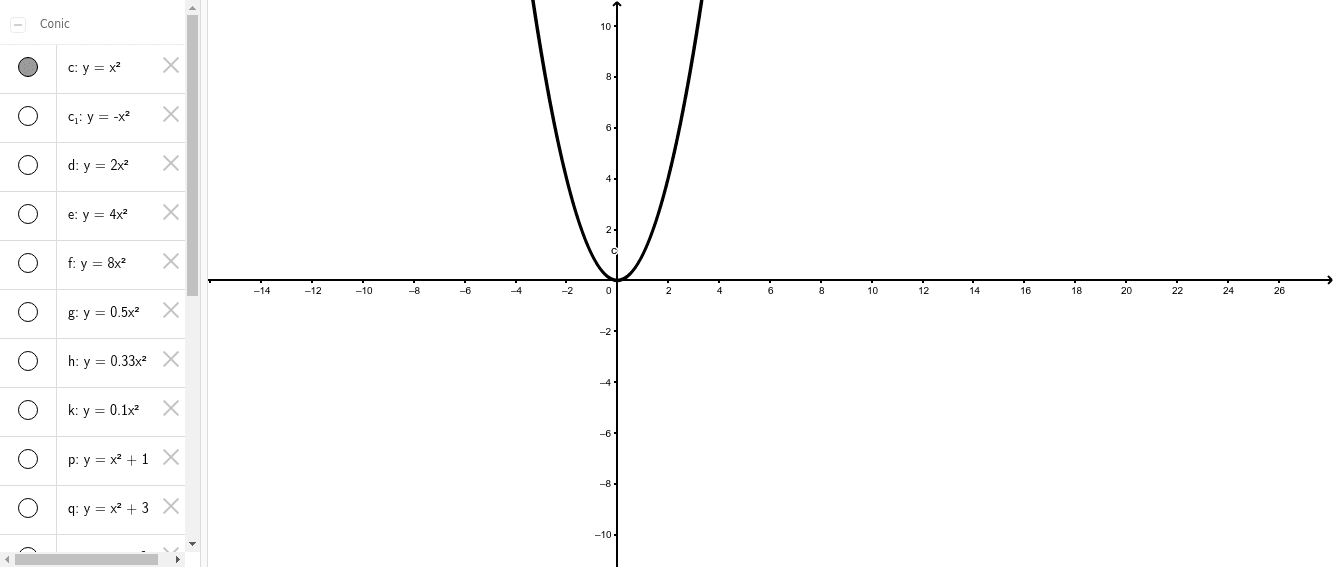
This example demonstrates the dynamic transformation of a parabola through parameterized shifting. It involves core mathematical concepts such as parabola equations, parametric equations, and dynamic geometric transformations. The construction utilizes GeoGebra commands/objects like points (c, d, e, f, g, h, k, p, q, r, s, t, u, u_1, u_3, v, v_1, v_2, t_1, c_1). It is suitable for high school mathematics students and teachers to understand function graph transformations and the impact of parameters on shapes.
GeoGebra Commands & Parameters
y = x^(2)y = (2 * x^(2))y = (4 * x^(2))Conic fy = (1 / 2 * x^(2))y = (1 / 3 * x^(2))y = (1 / 10 * x^(2))y = x^(2) + 1y = x^(2) + 3y = x^(2) + 6y = x^(2) - 2y = x^(2) - 4y = (x + 1)^(2)y = (x + 3)^(2)y = x^(2) + (10 * x) + 25y = x^(2) - (4 * x) + 4y = x^(2) - (8 * x) + 16y = x^(2) - (16 * x) + 64y = x^(2) - 8y = (-x^(2))
AI Drawing Prompt Reference
Draw a standard parabola opening upwards y=x². Then, draw parabolas with different coefficients: y=(2x²), y=(4x²), y=(1/2x²), y=(1/3x²), y=(1/10x²). Next, shift the parabola up along the y-axis: y=x²+1, y=x²+3, y=x²+6, y=x²-2, y=x²-4. Shift the parabola left along the x-axis: y=(x+1)², y=(x+3)². Then, rewrite the equations by completing the square: y=(x+5)², y=(x-2)², y=(x-4)², y=(x-8)². Finally, draw a parabola opening downwards: y=-x².
The prompt above was compiled from the original drawing commands and is for reference only.