
Parabola Art Creation: Andreea's 9D Classwork
Loading the math board and drawing, please wait…
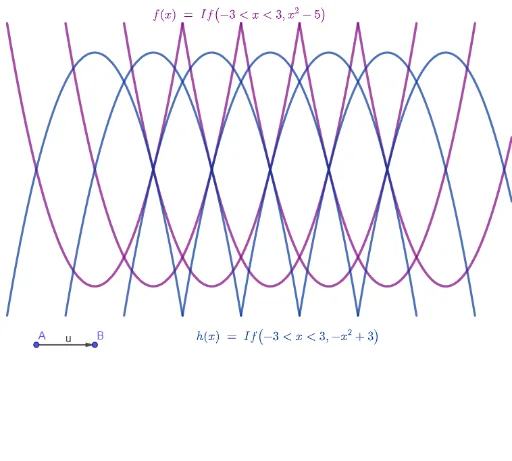
This GeoGebra example showcases an artistic composition centered on parabolas, combining multiple parabolas, lines, and similar triangles into a visually appealing pattern through geometric transformations such as translation and reflection. The core mathematical concepts involved include the definition and properties of parabolas, similar triangles, tangent lines, power functions, and set-theoretic relationships among geometric figures. The construction utilizes GeoGebra commands such as Vector, Translate, and Mirror, creating objects labeled f, A, B, u, f_1, g, g_1, a, g_2, b, h, h_1, p, c, p_1, p_2, and d, which are interconnected to form a layered geometric structure. This example is suitable for upper secondary students (grade 9 and above) studying analytic geometry, function transformations, or engaging in mathematical art projects. It reinforces understanding of parabolas while fostering creativity and aesthetic appreciation in mathematics.
GeoGebra Commands & Parameters
Vector(A, B) → uTranslate(f, u) → f_1Translate(f_1, u) → gTranslate(g, u) → g_1Mirror(f_1, yAxis) → aMirror(g, yAxis) → g_2Mirror(g_1, yAxis) → bTranslate(h, u) → h_1Translate(h_1, u) → pMirror(h_1, yAxis) → cMirror(p, yAxis) → p_1Translate(p, u) → p_2Mirror(p_2, yAxis) → d