
Parabola 1
Loading the math board and drawing, please wait…
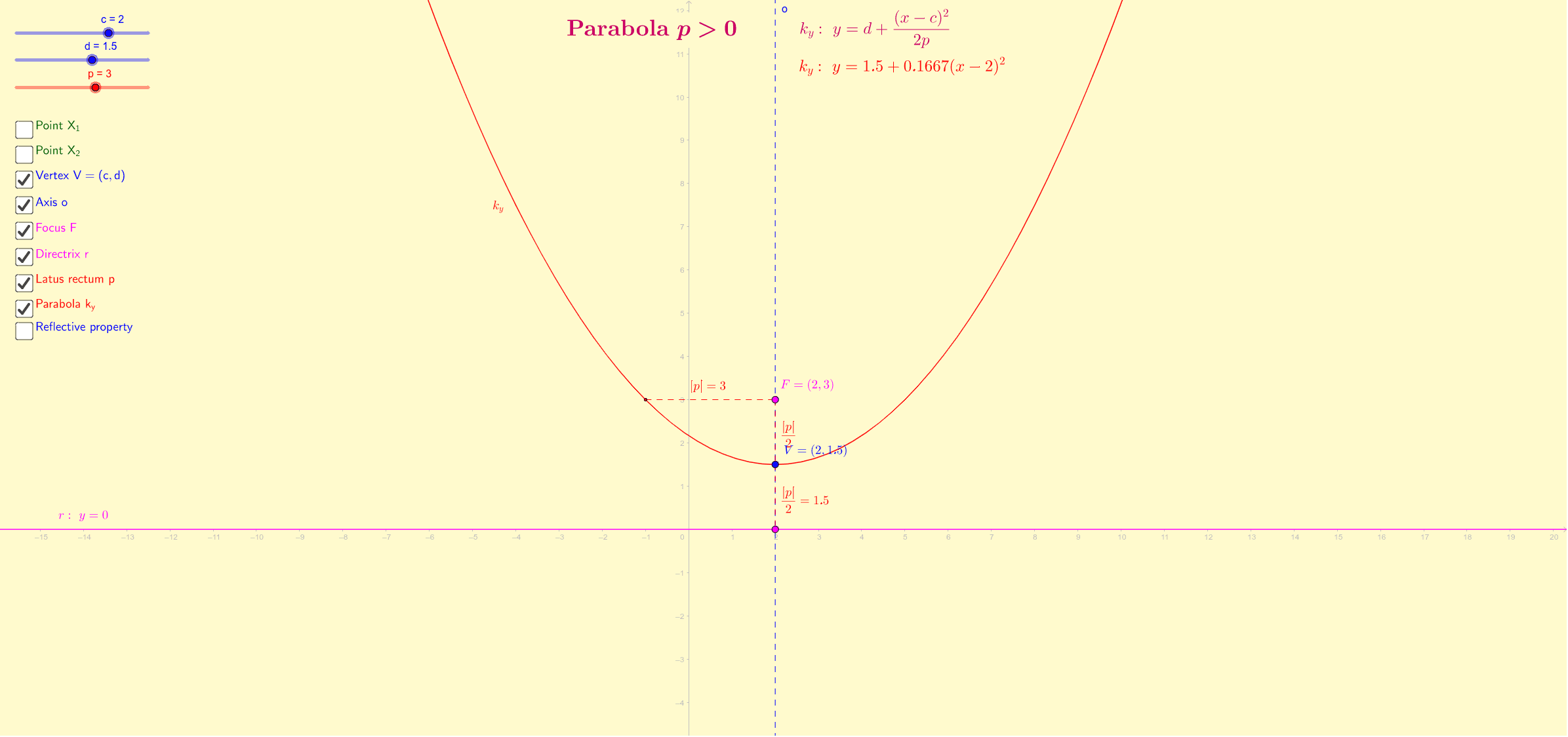
This example demonstrates the geometric properties of a parabola. It involves the basic definition and construction methods of a parabola. Using GeoGebra commands such as OrthogonalLine, Point, Segment, etc., it dynamically shows the process of generating a parabola. Suitable for high school mathematics education and learning.
GeoGebra Commands & Parameters
OrthogonalLine(F, r) → oPoint(ky) → X1Segment(F, X1) → fOrthogonalLine(X1, r) → gIntersect(r, g) → ASegment(X1, A) → hPoint(ky) → X2Segment(X2, F) → iOrthogonalLine(X2, r) → jIntersect(r, j) → BSegment(X2, B) → kSegment(F, V) → nIntersect(r, o) → CSegment(V, C) → mOrthogonalLine(F, o) → sIntersect(ky, s, 1) → ESegment(E, F) → tRay(LP, pv) → hdRay(L_5, pv) → h_5Ray(L_4, pv) → h_4Ray(L_3, pv) → h_3Ray(L_2, pv) → h_2Ray(L_1, pv) → h_1Ray(P_5, pv) → d_5Ray(P_4, pv) → d_4Ray(P_3, pv) → d_3Ray(P_2, pv) → d_2Ray(P_1, pv) → d_1Segment(L_1, F) → l_1Segment(L_2, F) → l_2Segment(L_3, F) → l_3Segment(L_4, F) → l_4Segment(L_5, F) → l_5Segment(LP, F) → lpSegment(P_1, F) → p_1Segment(P_2, F) → p_2Segment(P_3, F) → p_3Segment(P_4, F) → p_4Segment(P_5, F) → p_5