
Orthocenter and Circumcircle Dynamic Construction
Loading the math board and drawing, please wait…
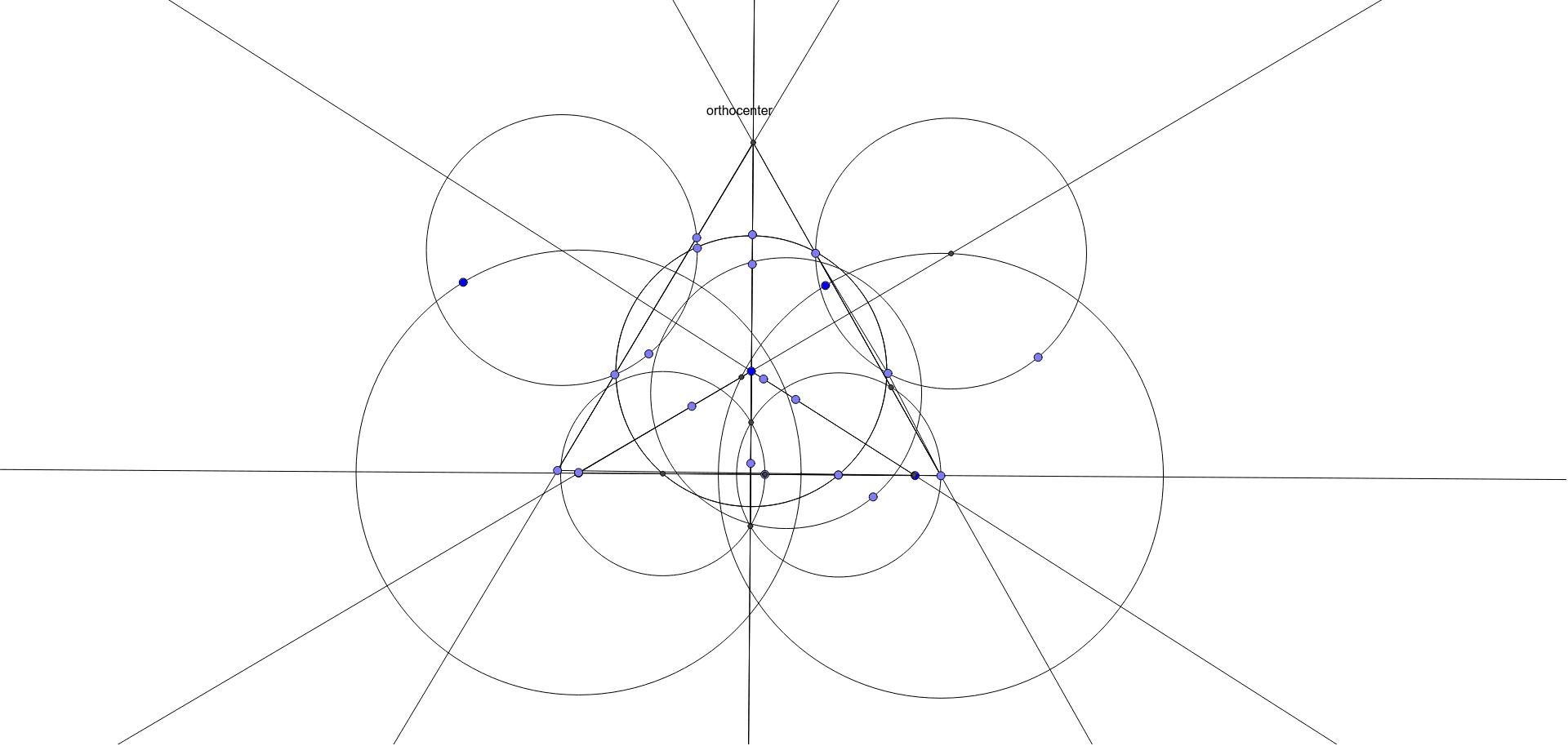
This example demonstrates the geometric construction of the orthocenter of a triangle and its relationship with the circumcircle. The core mathematical concepts include the orthocenter (intersection of the three altitudes), the circumcircle (circle passing through the three vertices), and the perpendicularity of altitudes. Construction details: using GeoGebra commands such as Segment, Point, Circle, Intersect, OrthogonalLine, and Line, the triangle ABC is built, then perpendicular lines to each side are drawn to find the orthocenter D, and the circumcircle c is constructed. Additional objects (feet of altitudes, extended lines, etc.) are generated to create an interactive dynamic figure. Suitable for middle and high school geometry classes, this helps students visualize the orthocenter's position for acute, right, and obtuse triangles, and explore properties like the Euler line or the nine-point circle.
GeoGebra Commands & Parameters
Segment(A, B) → fSegment(B, C) → gSegment(A, C) → hPoint(h) → DCircle(B, D) → cIntersect(c, h, 2) → EPoint(h) → FCircle(E, F) → dSegment(A_1, B_1) → f_1Segment(B_1, C_1) → g_1Segment(A_1, C_1) → h_1Point(h_1) → D_1Circle(B_1, D_1) → c_1Intersect(c_1, h_1, 2) → E_1Segment(A_2, B_2) → f_2Segment(B_2, C_2) → g_2Segment(A_2, C_2) → h_2Point(h_2) → D_2Circle(B_2, D_2) → c_2Intersect(c_2, h_2, 2) → E_2Point(h_2) → F_1Circle(E_2, F_1) → d_1Intersect(d, d_1, 1) → GIntersect(d, d_1, 2) → HSegment(B, H) → iSegment(H, B) → jOrthogonalLine(F, i) → kIntersect(k, h) → IIntersect(k, h) → JPoint(i) → KOrthogonalLine(K, h) → lPoint(f) → LLine(B, L) → mCircle(F_1, M) → eIntersect(e, m, 2) → NIntersect(e, m, 1) → OSegment(A_3, B_3) → f_3Segment(B_3, C_3) → g_3Segment(A_3, C_3) → h_3Point(h_3) → D_3Circle(B_3, D_3) → c_3Point(h_3) → F_2Segment(A_4, B_4) → f_4Segment(B_4, C_4) → g_4Segment(A_4, C_4) → h_4Point(h_4) → D_4Circle(B_4, D_4) → c_4Point(h_4) → F_3Point(c_4) → PPoint(c_4) → QSegment(F_1, Q) → nSegment(Q, P) → pSegment(F_1, P) → qIntersect(d_1, q, 2) → RLine(R, P) → rPoint(l) → SPoint(l) → TLine(S, T) → sPoint(g) → UPoint(g) → VLine(U, V) → tSegment(A_5, C_5) → h_5Point(h_5) → D_5Point(h_5) → F_4Circle(F_4, M_1) → e_1Segment(A_6, B_5) → f_5Segment(B_5, C_6) → g_5Segment(A_6, C_6) → h_6Point(h_6) → D_6Circle(B_5, D_6) → c_5Point(h_6) → F_5Segment(A_7, B_7) → f_6Segment(B_7, C_7) → g_6Segment(A_7, C_7) → h_7Point(h_7) → D_7Circle(B_7, D_7) → c_6Point(h_7) → F_6Point(c_5) → WPoint(c_5) → ZPoint(c_5) → G_1Line(W, G_1) → aIntersect(l, r) → H_1Point(a) → I_1Segment(I_1, H_1) → bSegment(F_1, I_1) → i_1Segment(H_1, F_1) → j_1Segment(I_1, H_1) → k_1Segment(K, H_1) → l_1Segment(B, F_4) → m_1