
Oriented Parametric Circles in 3D
Loading the math board and drawing, please wait…
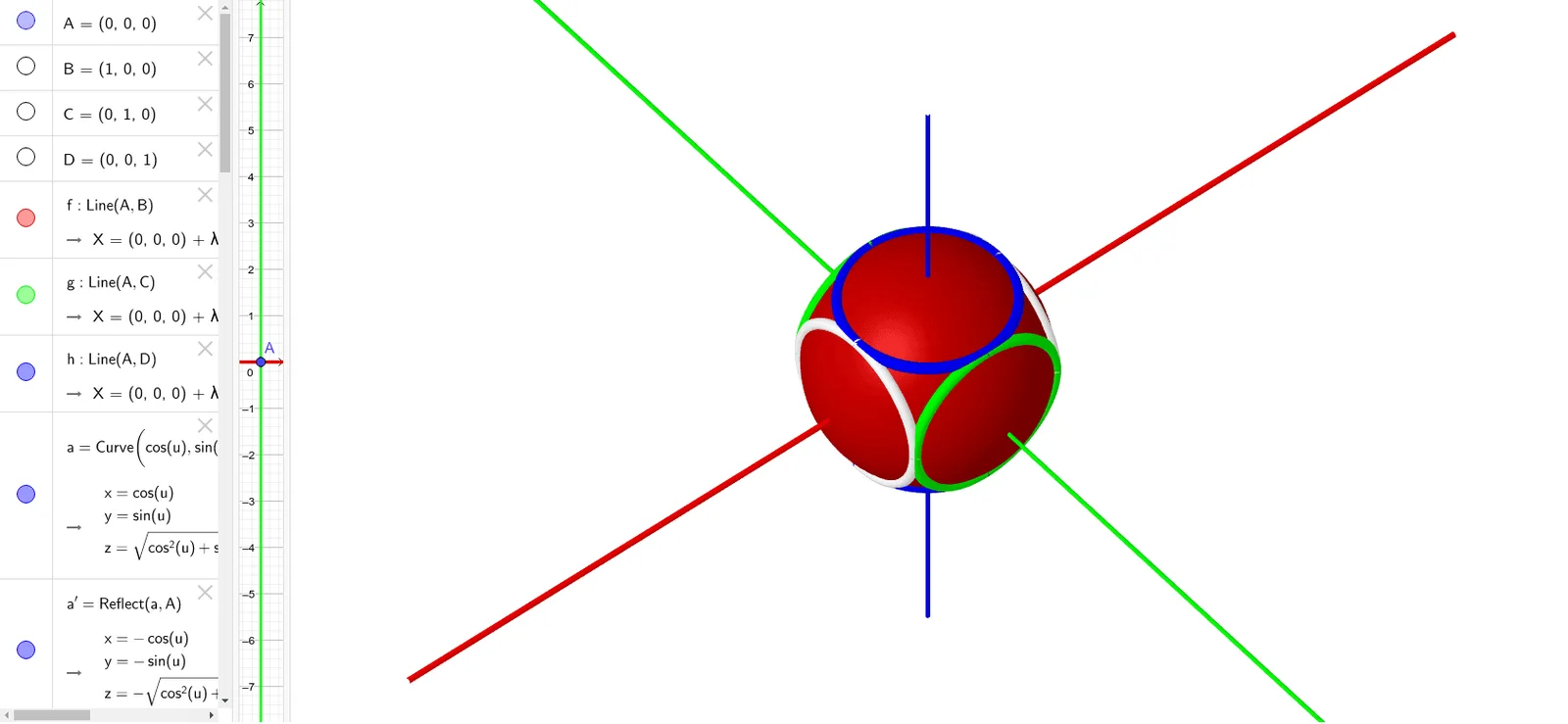
① This example demonstrates how to construct oriented parametric circles in 3D space, with a normal direction, and generate a family of related circles through mirroring and rotation. ② Core mathematical concepts include parametric curves, parametric equations of circles, direction vectors in 3D, mirror and rotation transformations, and the geometric relationship between spheres and circles. ③ Construction highlights: from the summary, commands such as Line, CurveCartesian, Mirror, Rotate, and Sphere are used, involving objects like points A, B, C, D, curves f, g, h, and their mirrored/rotated copies (e.g., a', a'_1, etc.), defining circles parametrically and applying transformations to create oriented circle families. ④ Suitable for high school or university-level analytic geometry, solid geometry, or computer-aided geometry teaching, providing an intuitive visualization of 3D parametric curves, direction vectors, and spatial transformations.
GeoGebra Commands & Parameters
Line(A, B) → fLine(A, C) → gLine(A, D) → hCurveCartesian(cos(u), sin(u), sqrt(cos(u)^(2) + sin(u)^(2)), u, 0, (2 * π)) → aMirror(a, A) → a'Rotate(a, π / 2, g) → a'_1Mirror(a'_1, A) → bRotate(a, π / 2, f) → a'_2Mirror(a'_2, A) → cSphere(A, sqrt(2)) → dLine(A_1, B_1) → f_1Line(A_1, C_1) → g_1Line(A_1, D_1) → h_1CurveCartesian(cos(u), sin(u), sqrt(cos(u)^(2) + sin(u)^(2)), u, 0, (2 * π)) → a_1Mirror(a_1, A_1) → a'_3Rotate(a_1, π / 2, g_1) → a'_4Mirror(a'_4, A_1) → b_1Rotate(a_1, π / 2, f_1) → a'_5Mirror(a'_5, A_1) → c_1Sphere(A_1, sqrt(2)) → d_1
AI Drawing Prompt Reference
In 3D space, draw a sphere with radius sqrt(2) centered at a point. From this center, create three reference lines along distinct directions. On the sphere, define a closed parametric circle using a curve that lies on the sphere's surface. Mirror this circle about the center point to get a second curve. Then rotate the original circle by 90 degrees about one reference linehol, mirror the result about the center, and similarly rotate about another reference line and mirror again, producing a family of four oriented circles. Repeat the entire construction at a second center point to generate a second identical family of circles, each associated with its own sphere.
The prompt above was compiled from the original drawing commands and is for reference only.