
Oblique Prism Net 2
Loading the math board and drawing, please wait…
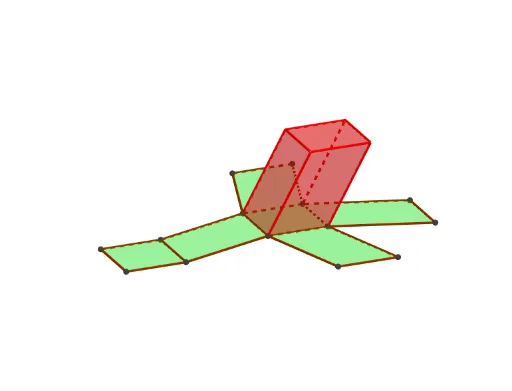
① This example demonstrates how to construct the net (unfolded surface) of an oblique prism using GeoGebra, showing all lateral faces and bases laid out in a single plane. ② Core mathematical concepts include solid geometry, oblique prisms, nets, polygons, dilation (similarity transformation), and circumcircles, relating 3D shapes to their 2D unfoldings. ③ Construction highlights: from the summary, commands such as Polygon, Prism, and Net are used, with vertices A, B, C, D and corresponding lateral vertices E, F, G, H, defining faces (e.g., liceABIE, liceBCJI) and edges (ivicaAE, ivicaBI), and applying dilation to create the net. ④ Suitable for high school or early college geometry classes, this interactive model helps students visualize the structure of oblique prisms, understand nets and surface area, and explore dynamic geometry.
GeoGebra Commands & Parameters
Polygon(A, B, C, D) → q1, a, b, c, dPrism(q1, E) → e, I, ivicaBI, ivicaCJ, ivicaDK, ivicaEI, ivicaIJ, ivicaJK, ivicaEK, J, K, liceABIE, liceBCJI, liceCDKJ, liceADKE, liceEIJK, ivicaAENet(e, f) → g, L, U, V, W, Z, A_1, liceLMNO, liceLMQP, liceMNSR, liceNOUT, liceLOVW, M, lice1, ivicaLM, ivicaMN, ivicaNO, ivicaLO, ivicaLP, ivicaPQ, ivicaMQ, ivicaMR, ivicaRS, N, ivicaNS, ivicaNT, ivicaTU, ivicaOU, ivicaOV, ivicaVW, ivicaLW, ivicaQZ, ivica2, ivica1, O, P, Q, R, S, T