
Number Wall by FLINK-Team
Loading the math board and drawing, please wait…
In collections
Rechnen mit Potenzen
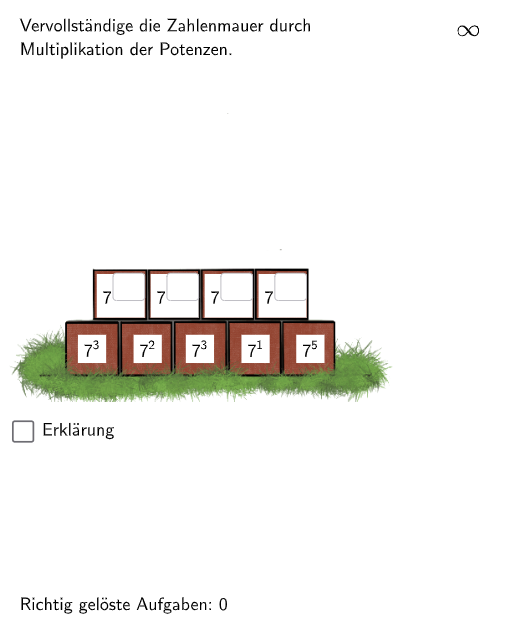
The Number Wall is a mathematical tool that demonstrates the relationship between numbers. It helps students understand the concept and rules of exponents. By adjusting the parameters of the Number Wall, students can observe the relationships and patterns between different exponents. The Number Wall can also be used to show the decomposition and composition of numbers. It is a useful tool for middle school students learning exponents and exponent operations.
GeoGebra Commands & Parameters
Shuffle(1…5) → Expo1List, {3, 5, 4, 2, 1}Shuffle(1…5) → Expo2List, {2, 5, 3, 1, 4}Shuffle(1…5) → Expo3List, {3, 4, 1, 2, 5}Shuffle(1…5) → Expo4List, {1, 5, 4, 2, 3}Shuffle(1…5) → Expo5List, {5, 1, 4, 3, 2}Textfield(aInput) → InputBox1Textfield(bInput) → InputBox2Textfield(cInput) → InputBox3Textfield(dInput) → InputBox4Textfield(eInput) → InputBox5Textfield(fInput) → InputBox6Textfield(gInput) → InputBox7Textfield(hInput) → InputBox8Textfield(iInput) → InputBox9Textfield(jInput) → InputBox10Shuffle(Sequence[Random[2, 16], i, 1, 100]) → randomNos, {12, 7, 6, 2, 4, 5, 10, 9, 2, 15, 3, 9, 4, 8, 8, 11, 4, 11, 14, 6, 2, 6, 3, 10, 14, 7, 16, 3, 11, 7, 10, 7, 4, 13, 14, 12, 7, 5, 4, 11, 10, 10, 14, 6, 9, 8, 16, 9, 3, 5, 10, 11, 14, 16, 11, 13, 15, 12, 16, 3, 5, 9, 6, 10, 5, 4, 5, 7, 2, 4, 12, 4, 5, 5, 16, 15, 8, 10, 15, 3, 4, 10, 10, 4, 15, 13, 11, 14, 6, 8, 16, 7, 5, 8, 6, 2, 15, 16, 3, 13}Shuffle(Sequence[Random[1, numB - 1], i, 1, 100]) → randomNos1, {1, 1, 1, 1, 1, 1, 1, 1, 1, 1, 1, 1, 1, 1, 1, 1, 1, 1, 1, 1, 1, 1, 1, 1, 1, 1, 1, 1, 1, 1, 1, 1, 1, 1, 1, 1, 1, 1, 1, 1, 1, 1, 1, 1, 1, 1, 1, 1, 1, 1, 1, 1, 1, 1, 1, 1, 1, 1, 1, 1, 1, 1, 1, 1, 1, 1, 1, 1, 1, 1, 1, 1, 1, 1, 1, 1, 1, 1, 1, 1, 1, 1, 1, 1, 1, 1, 1, 1, 1, 1, 1, 1, 1, 1, 1, 1, 1, 1, 1, 1}Defined(startInput) → fixed2Textfield(startInput) → InputBox11SpeechBubbleLeft(I, 6, 1) → poly1SpeechBubbleLeft(R, 8.6, 1.6) → poly2LCM(numB, numB1) → kgv1LCM(numB1, numB2) → kgv2LCM(numB2, numB3) → kgv3LCM(numB3, numB4) → kgv4LCM(kgv1, kgv2) → kgv2_1LCM(kgv2, kgv3) → kgv2_2LCM(kgv3, kgv4) → kgv2_3LCM(kgv2_1, kgv2_2) → kgv3_1LCM(kgv2_2, kgv2_3) → kgv3_2LCM(kgv3_1, kgv3_2) → kgv4_1If(questionCount < 4, questionCount, 4) → metaprogressionShuffle(Sequence[i, i, 1, 9]) → XStartList, {7, 5, 3, 1, 2, 8, 9, 4, 6}Shuffle(Sequence[i, i, -20, 50]) → XDeziHelper, {41, 15, 40, 16, -11, 27, 33, -7, -5, 35, 30, 4, 48, 7, 31, -13, -3, -1, 45, -20, -12, -4, 10, -16, 42, 11, 17, 0, 36, 9, 23, -15, 44, 38, -10, 5, -6, 46, 3, 34, -2, 50, 14, 6, 2, 22, 25, 21, 12, -14, 28, -9, 37, 39, 29, 19, -18, -19, 1, 20, 32, 24, -17, 43, 8, 13, 26, 49, 18, 47, -8}Shuffle(Sequence[i, i, -10, 10] \ {0}) → XGanzzahlList, {-10, 3, 9, 7, 8, 6, -7, -1, -5, -4, 10, 4, -8, 5, -6, -3, 1, -9, -2, 2}Shuffle(Join[{XDezizahlList, XGanzzahlList}]) → XMidList, {2.2, -0.9, 2.1, 4.7, 4.5, -0.8, 4.3, -6, -1.5, 2.6, 4, -10, -1.3, -1.7, 6, -0.3, 3.1, -0.5, -1, 0.1, 4.4, -3, -1.2, 8, -2, 7, 3.3, 4.2, 1.2, -4, 1.8, 1.3, 3.8, 3, -9, 2.4, 1, 0.6, -0.2, 1.6, 3.4, 4.9, 2.5, -0.6, -1, 0.3, 0.5, 3.5, -1.8, 2, 1.9, 4.8, 2.3, 5, -0.7, 2.8, 0.2, 4, 0.8, -1.6, 1.1, -2, 1.4, 1.5, -1.9, 4.6, 0.4, -0.1, 1.7, 3.9, -0.4, 10, 4.1, 9, -1.1, 2, -8, 3, 5, 3.7, -7, 0.7, 0.9, 2.9, 3.6, -1.4, 1, 3.2, -5, 2.7}Length({c1, c2, c3, c4, c5, c6, c7, c8, c9, c10} \ {false}) → correctnumberLength(ShowTrueList) → showanzahlText((((("\textsf{\textcolor{006758}{" * xValue) * "^{") * cell4) * "}}"), USolP14, true, true, 0, 0) → USol14Text((((("\textsf{\textcolor{006758}{" * xValue) * "^{") * cell1) * "}}"), USolP11, true, true, 0, 0) → USol11Text((((("\textsf{\textcolor{006758}{" * xValue) * "^{") * cell2) * "}}"), USolP12, true, true, 0, 0) → USol12Text((((("\textsf{\textcolor{006758}{" * xValue) * "^{") * cell3) * "}}"), USolP13, true, true, 0, 0) → USol13Text((((("\textsf{\textcolor{006758}{" * xValue) * "^{") * cell5) * "}}"), USolP21, true, true, 0, 0) → USol21Text((((("\textsf{\textcolor{006758}{" * xValue) * "^{") * cell6) * "}}"), USolP22, true, true, 0, 0) → USol22Text((((("\textsf{\textcolor{006758}{" * xValue) * "^{") * cell7) * "}}"), USolP23, true, true, 0, 0) → USol23Text((((("\textsf{\textcolor{006758}{" * xValue) * "^{") * cell8) * "}}"), USolP31, true, true, 0, 0) → USol31Text((((("\textsf{\textcolor{006758}{" * xValue) * "^{") * cell9) * "}}"), USolP32, true, true, 0, 0) → USol32Text((((("\textsf{\textcolor{006758}{" * xValue) * "^{") * cell10) * "}}"), USolP41, true, true, 0, 0) → USol41
AI Drawing Prompt Reference
Create a mathematical tool to demonstrate the relationship between numbers, including multiple inequality display areas. Use randomly generated number lists and input boxes to show exponent operations, with colored text bubbles indicating solution steps and results. The construction sequence should be: first generate random number lists and input boxes, then calculate the least common multiple based on inputs, and finally display the solution process and results in text bubbles, ensuring all elements are clearly presented and maintain logical relationships.
The prompt above was compiled from the original drawing commands and is for reference only.