
Number Sense - Level 1 (Decimal Numbers)
Loading the math board and drawing, please wait…
In collections
Rationale Zahlen & Arbeiten mit der Zahlengerade
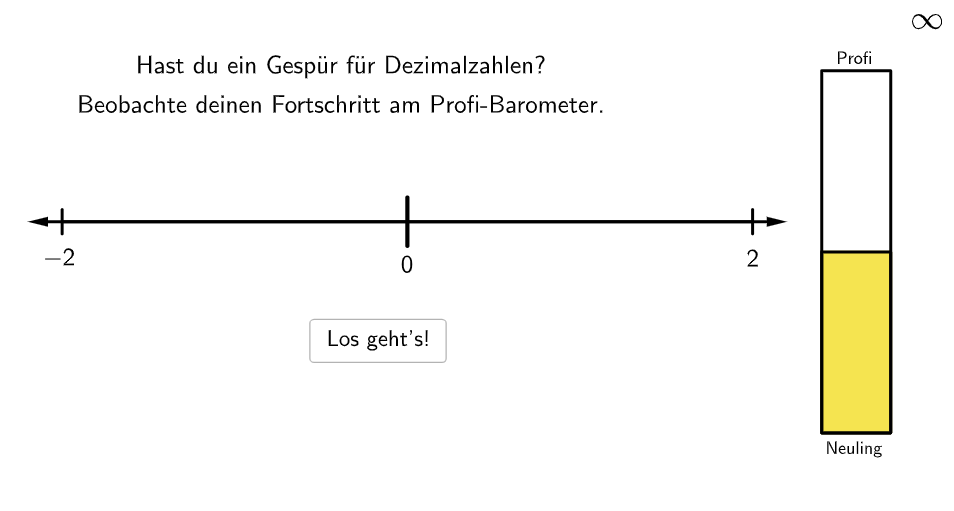
This interactive GeoGebra activity is designed for students in grades 7-8 to practice number sense, specifically comparing and ordering rational numbers (with a focus on decimals) and representing them on a number line. The core mathematical concepts include rational number comparison, ordering, placement on the number line, distinguishing positive, negative, and zero, and understanding decimal-fraction relationships. The construction uses a variety of GeoGebra commands such as RandomElement, Vector, Segment, Join, Remove, Unique, Element, Polygon, If, and Text to generate random numbers and create interactive elements like buttons and sliders (e.g., button1, slider) for controlling difficulty and revealing solutions. Key objects include barometer (progress indicator), numbersAll (list of all numbers), numbers (current set), numDif, numZero, numPos for categorizing numbers. This resource is suitable for classroom use as a formative assessment or for individual student practice to reinforce rational number concepts and number line skills.
GeoGebra Commands & Parameters
RandomElement(minNums) → minNumRandomElement(maxNums) → maxNumVector(A + (0.5, 0), B) → uSegment((10, b), (10, (-b))) → gJoin({{100}, Shuffle[Sequence[Random[5, 95], i, 1, 100]]}) → randomNosRemove((((minNum * 10) + 1)…0) / 10, numbersGanze) → numbers3Dezimal1NegRemove((0…((maxNum * 10) - 1)) / 10, numbersGanze) → numbers4Dezimal1PosRemove((((minNum * 100) + 1)…0) / 100, Flatten[{numbersGanze, numbers3Dezimal1Neg}]) → numbers5Dezimal2NegRemove((0…((maxNum * 100) - 1)) / 100, Flatten[{numbersGanze, numbers4Dezimal1Pos}]) → numbers6Dezimal2PosUnique(Flatten[Zip[Sequence[Sequence[j - i / a, i, 1, a - 1], j, minNum + 1, 0], a, {2, 3, 4, 5, 6, 8, 10}]]) → numbers1BruecheNegUnique(Flatten[Zip[Sequence[Sequence[j + i / a, i, 1, a - 1], j, 0, maxNum - 1], a, {2, 3, 4, 5, 6, 8, 10}]]) → numbers2BruechePosJoin(Sequence[Shuffle[{3, 3, 4, 5, 5, 6}], i, 1, 10]) → numbersToTakeWSKElement(numbersToTakeWSK, Mod[count, Length[numbersToTakeWSK]] + 1) → actualNumberToTakeWSKElement(numbersAll, actualNumberToTakeWSK) → numbersRandomElement(numbers) → numPolygon((Max[0, If[numPos ≥ numZero > numPos - 0.5, numZero, numPos - 0.5]], -0.3), (Min[10, If[numPos < numZero ≤ numPos + 0.5, numZero, numPos + 0.5]], -0.3), (Min[10, If[numPos < numZero ≤ numPos + 0.5, numZero, numPos + 0.5]], 0.3), (Max[0, If[numPos ≥ numZero > numPos - 0.5, numZero, numPos - 0.5]], 0.3)) → q1, h, i, j, kSegment((0, 0), (0.1, 0)) → P0Segment((0.1, 0), (0.2, 0)) → P1Segment((0.2, 0), (0.3, 0)) → P2Segment((0.3, 0), (0.4, 0)) → P3Segment((0.4, 0), (0.5, 0)) → P4Segment((0.5, 0), (0.6, 0)) → P5Segment((0.6, 0), (0.7, 0)) → P6Segment((0.7, 0), (0.8, 0)) → P7Segment((0.8, 0), (0.9, 0)) → P8Segment((0.9, 0), (1, 0)) → P9Segment((1, 0), (1.1, 0)) → P10Segment((1.1, 0), (1.2, 0)) → P11Segment((1.2, 0), (1.3, 0)) → P12Segment((1.3, 0), (1.4, 0)) → P13Segment((1.4, 0), (1.5, 0)) → P14Segment((1.5, 0), (1.6, 0)) → P15Segment((1.6, 0), (1.7, 0)) → P16Segment((1.7, 0), (1.8, 0)) → P17Segment((1.8, 0), (1.9, 0)) → P18Segment((1.9, 0), (2, 0)) → P19Segment((2, 0), (2.1, 0)) → P20Segment((2.1, 0), (2.2, 0)) → P21Segment((2.2, 0), (2.3, 0)) → P22Segment((2.3, 0), (2.4, 0)) → P23Segment((2.4, 0), (2.5, 0)) → P24Segment((2.5, 0), (2.6, 0)) → P25Segment((2.6, 0), (2.7, 0)) → P26Segment((2.7, 0), (2.8, 0)) → P27Segment((2.8, 0), (2.9, 0)) → P28Segment((2.9, 0), (3, 0)) → P29Segment((3, 0), (3.1, 0)) → P30Segment((3.1, 0), (3.2, 0)) → P31Segment((3.2, 0), (3.3, 0)) → P32Segment((3.3, 0), (3.4, 0)) → P33Segment((3.4, 0), (3.5, 0)) → P34Segment((3.5, 0), (3.6, 0)) → P35Segment((3.6, 0), (3.7, 0)) → P36Segment((3.7, 0), (3.8, 0)) → P37Segment((3.8, 0), (3.9, 0)) → P38Segment((3.9, 0), (4, 0)) → P39Segment((4, 0), (4.1, 0)) → P40Segment((4.1, 0), (4.2, 0)) → P41Segment((4.2, 0), (4.3, 0)) → P42Segment((4.3, 0), (4.4, 0)) → P43Segment((4.4, 0), (4.5, 0)) → P44Segment((4.5, 0), (4.6, 0)) → P45Segment((4.6, 0), (4.7, 0)) → P46Segment((4.7, 0), (4.8, 0)) → P47Segment((4.9, 0), (5, 0)) → P49Segment((5, 0), (5.1, 0)) → P50Segment((5.1, 0), (5.2, 0)) → P51Segment((5.2, 0), (5.3, 0)) → P52Segment((5.3, 0), (5.4, 0)) → P53Segment((5.4, 0), (5.5, 0)) → P54Segment((5.5, 0), (5.6, 0)) → P55Segment((5.6, 0), (5.7, 0)) → P56Segment((5.7, 0), (5.8, 0)) → P57Segment((5.8, 0), (5.9, 0)) → P58Segment((5.9, 0), (6, 0)) → P59Segment((6, 0), (6.1, 0)) → P60Segment((6.1, 0), (6.2, 0)) → P61Segment((6.2, 0), (6.3, 0)) → P62Segment((6.3, 0), (6.4, 0)) → P63Segment((6.4, 0), (6.5, 0)) → P64Segment((6.5, 0), (6.6, 0)) → P65Segment((6.6, 0), (6.7, 0)) → P66Segment((6.7, 0), (6.8, 0)) → P67Segment((6.8, 0), (6.9, 0)) → P68Segment((6.9, 0), (7, 0)) → P69Segment((7, 0), (7.1, 0)) → P70Segment((7.1, 0), (7.2, 0)) → P71Segment((7.2, 0), (7.3, 0)) → P72Segment((7.3, 0), (7.4, 0)) → P73Segment((7.4, 0), (7.5, 0)) → P74Segment((7.5, 0), (7.6, 0)) → P75Segment((7.6, 0), (7.7, 0)) → P76Segment((7.7, 0), (7.8, 0)) → P77Segment((7.8, 0), (7.9, 0)) → P78Segment((7.9, 0), (8, 0)) → P79Segment((8, 0), (8.1, 0)) → P80Segment((8.1, 0), (8.2, 0)) → P81Segment((8.2, 0), (8.3, 0)) → P82Segment((8.3, 0), (8.4, 0)) → P83Segment((8.4, 0), (8.5, 0)) → P84Segment((8.5, 0), (8.6, 0)) → P85Segment((8.6, 0), (8.7, 0)) → P86Segment((8.7, 0), (8.8, 0)) → P87Segment((8.8, 0), (8.9, 0)) → P88Segment((8.9, 0), (9, 0)) → P89Segment((9, 0), (9.1, 0)) → P90Segment((9.1, 0), (9.2, 0)) → P91Segment((9.2, 0), (9.3, 0)) → P92Segment((9.3, 0), (9.4, 0)) → P93Segment((9.4, 0), (9.5, 0)) → P94Segment((9.5, 0), (9.6, 0)) → P95Segment((9.6, 0), (9.7, 0)) → P96Segment((9.7, 0), (9.8, 0)) → P97Segment((9.8, 0), (9.9, 0)) → P98Segment((9.9, 0), (10, 0)) → P99Segment((10, 0), (10.1, 0)) → P100Segment((4.8, 0), (4.9, 0)) → P48If(floor(barometer / 2) + 1 ≥ 10, 10, floor(barometer / 2) + 1) → colorIndexPolygon((-1, -7), (17, -7), (17, 4), (-1, 4)) → canvas, l, m, n, pVector(B - (0.5, 0), A) → u1Segment((0, b), (0, (-b))) → g1Segment((numZero, a), (numZero, (-a))) → fVector((numPos, -0.4), (numPos, 0)) → vElement(randomNos, Mod[count, Length[randomNos]] + 1) → randomNumUnusedText("\textsf{" + numText + "}", (numPos - 0.02, -1.0), true, true, 0, 0) → text6
AI Drawing Prompt Reference
Draw a number line from 0 to 10, marking several random decimal numbers, including positive, negative, and fractional numbers. Use green rectangles to represent positive numbers, red rectangles for negative numbers, and blue rectangles for decimals. Divide the number line into 10 units with line segments, from 0 to 10. Randomly generate numbers including integers, one-decimal-place numbers, two-decimal-place numbers, and fractional numbers, ensuring their relative positions are clearly shown on the number line.
The prompt above was compiled from the original drawing commands and is for reference only.