
Number Systems
Loading the math board and drawing, please wait…
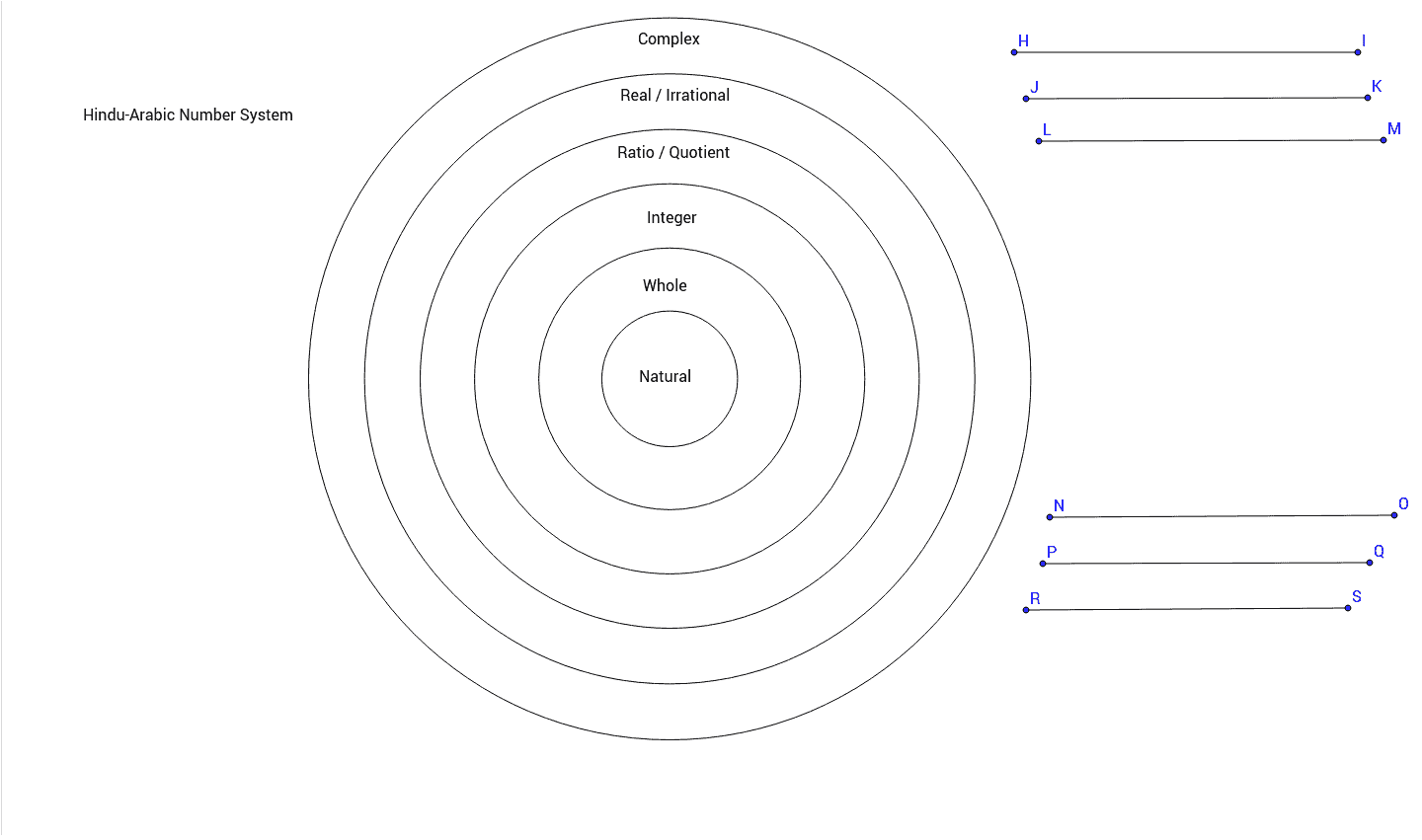
This example demonstrates the geometric representation and relationships of different number systems (natural, real, complex numbers, etc.). Core math concepts include addition, algebra, arithmetic, calculus, complex numbers, natural numbers, real numbers, combinatorics, derivatives, rhombuses, geometric constructions, and ratios. It is constructed using GeoGebra commands like Intersect, Circle, Segment, and objects such as A, B, c, C, d, D, e, E, f, F, g, G, h, text1, text2, text3, text4, text5, text6, text7, H, I, a, J, K, b, L, M, i, N, O, j, P, Q, k, R, S, l. Suitable for high school students and teachers to visualize and understand number systems and their geometric connections.
GeoGebra Commands & Parameters
Intersect(xAxis, yAxis) → ACircle(A, B) → cCircle(A, C) → dCircle(A, D) → eCircle(A, E) → fCircle(A, F) → gCircle(A, G) → hSegment(H, I) → aSegment(J, K) → bSegment(L, M) → iSegment(N, O) → jSegment(P, Q) → kSegment(R, S) → l
AI Drawing Prompt Reference
Draw a graph with multiple circles and line segments. Start from the intersection point A of the x-axis and y-axis. Then draw circles c, d, e, f, g, h from A. Next, draw line segments a, b, i, j, k, l. These circles and line segments can illustrate geometric relationships of different number systems. The graph should be clear and easy to understand for teaching.
The prompt above was compiled from the original drawing commands and is for reference only.