
Nth Roots of a General Complex Number
Loading the math board and drawing, please wait…
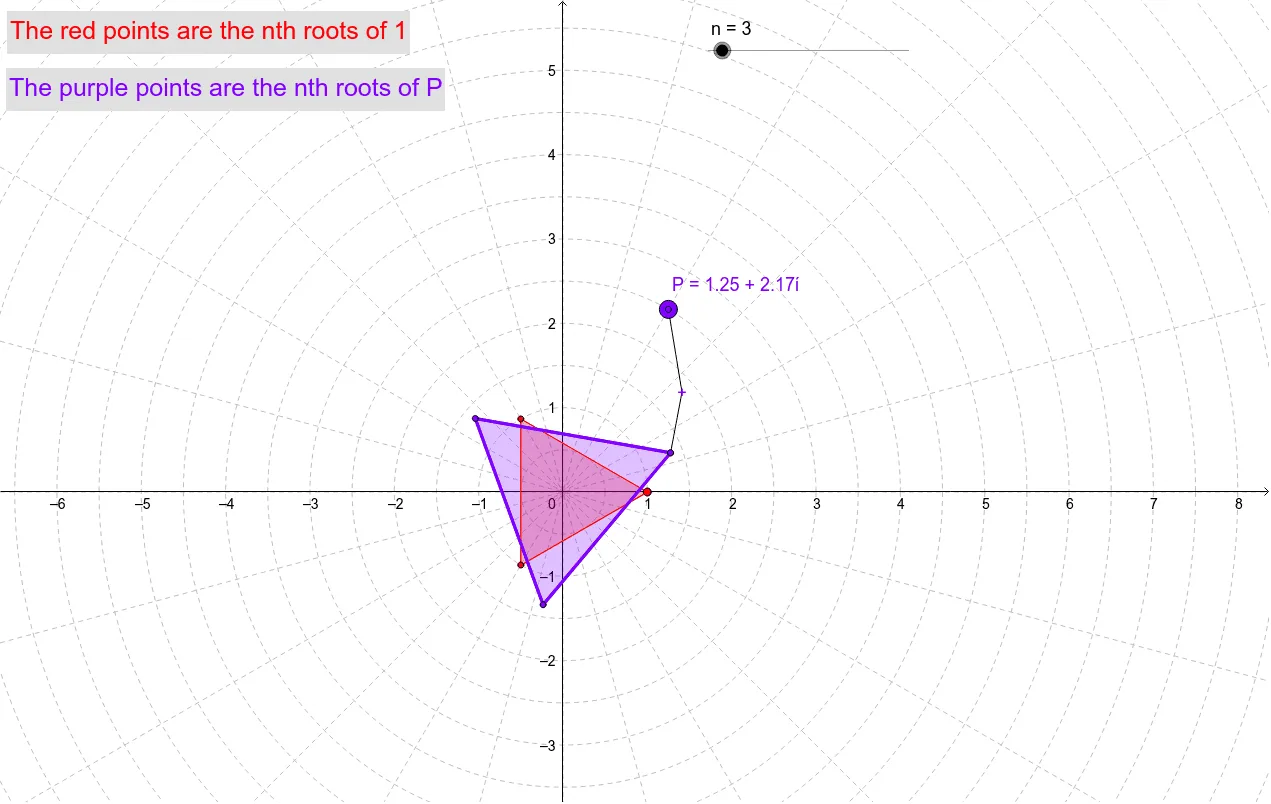
This example provides a visualization of the nth roots of a general complex number in the complex plane. Key mathematical concepts include the nth roots of complex numbers and their geometric representation in the complex plane. Using GeoGebra commands such as Point, Polygon, Min, and Segment, you can dynamically explore the nth roots for different values of n. Suitable for high school mathematics education and learning about complex numbers.
GeoGebra Commands & Parameters
Point(xAxis) → APolygon(A, ω, n) → poly1, a, j, k, l, m, p, q, r, s, t, a_1, b, b_1, c_1, d_1, e_1, f_1, g_1, h_1, i_1, j_1, k_1, c, l_1, B, C, D, E, F, G, H, I, J, d, K, L, M, N, O, P_2, Q, R, S, T, e, U, V, W, Z, A_1, B_1, C_1, D_1, E_1, f, g, h, iPolygon(z_2, z_3, n) → poly2, d_3, p_1, q_1, r_1, s_1, t_1, a_2, b_2, c_2, d_2, e_2, e_3, f_2, g_2, h_2, i_2, j_2, k_2, l_2, m_2, n_2, p_2, f_3, q_2, F_1, G_1, H_1, I_1, J_1, K_1, L_1, M_1, N_1, g_3, O_1, P_1, Q_1, R_1, S_1, T_1, U_1, V_1, W_1, Z_1, h_3, A_2, B_2, C_2, D_2, E_2, F_2, G_2, H_2, I_2, i_3, j_3, m_1, n_1Min(n, A1 + 1) → A2Min(n, A2 + 1) → A3Min(n, A3 + 1) → A4Min(n, A4 + 1) → A5Min(n, A5 + 1) → A6Min(n, A6 + 1) → A7Min(n, A7 + 1) → A8Min(n, A8 + 1) → A9Min(n, A9 + 1) → A10Min(n, A10 + 1) → A11Min(n, A11 + 1) → A12Min(n, A12 + 1) → A13Min(n, A13 + 1) → A14Min(n, A14 + 1) → A15Min(n, A15 + 1) → A16Min(n, A16 + 1) → A17Min(n, A17 + 1) → A18Min(n, A18 + 1) → A19Min(n, A19 + 1) → A20Min(n, A20 + 1) → A21Min(n, A21 + 1) → A22Min(n, A22 + 1) → A23Min(n, A23 + 1) → A24Min(n, A24 + 1) → A25Min(n, A25 + 1) → A26Min(n, A26 + 1) → A27Min(n, A27 + 1) → A28Min(n, A28 + 1) → A29Min(n, A29 + 1) → A30Segment(z_2, B2) → r_2Segment(B2, B3) → s_2Segment(B3, B4) → t_2Segment(B4, B5) → a_3Segment(B5, B6) → b_3Segment(B6, B7) → c_3Segment(B7, B8) → k_3Segment(B8, B9) → l_3Segment(B9, B10) → m_3Segment(B10, B11) → n_3Segment(B11, B12) → p_3Segment(B12, B13) → q_3Segment(B13, B14) → r_3Segment(B14, B15) → s_3Segment(B15, B16) → t_3Segment(B16, B17) → a_4Segment(B17, B18) → b_4Segment(B18, B19) → c_4Segment(B19, B20) → d_4Segment(B20, B21) → e_4Segment(B21, B22) → f_4Segment(B22, B23) → g_4Segment(B23, B24) → h_4Segment(B24, B25) → i_4Segment(B25, B26) → j_4Segment(B26, B27) → k_4Segment(B27, B28) → l_4Segment(B28, B29) → m_4Segment(B29, P) → n_4
AI Drawing Prompt Reference
Visualize the nth roots of a complex number in the complex plane by marking a point on the real axis and drawing multiple polygons based on this point to represent the roots for different values of n, connecting the vertices of these polygons with line segments to show the distribution and geometric relationships of the roots, starting from the point on the real axis and expanding outward to form a complete distribution map of the roots.
The prompt above was compiled from the original drawing commands and is for reference only.