
Nets of a Tetrahedron by Dr. Dunphy
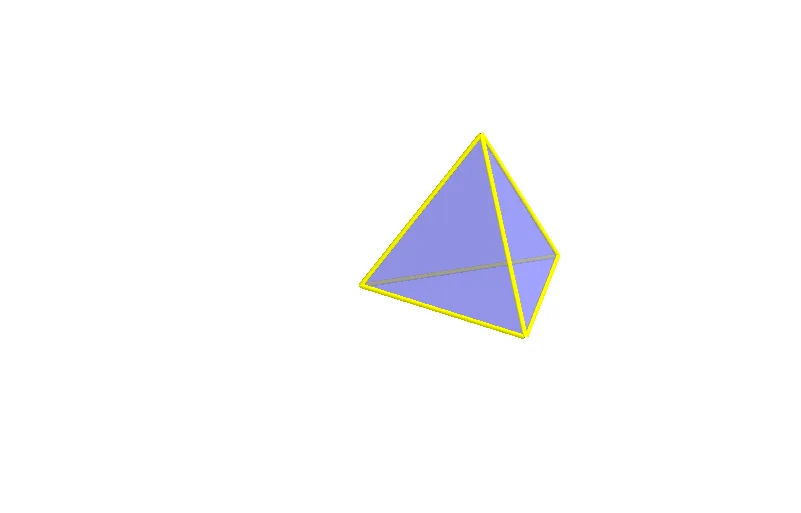
Loading the math board and drawing, please wait…
This example demonstrates the net of a tetrahedron and its fundamental properties. It involves core mathematical concepts such as solid geometry, polygons, angles, and transformations. The construction utilizes GeoGebra commands and objects like Tetrahedron, OrthogonalPlane, IntersectPath, Intersect, Angle, Rotate, OrthogonalLine, Polygon, and Segment. It is suitable for high school students and teachers studying solid geometry, aiding in understanding the unfolding and reconstruction of polyhedra.
GeoGebra Commands & Parameters
Tetrahedron(A, B, xOyPlane) → a, C, edgeAD_1, edgeCD, edgeBD_1, D, faceABC, faceACD, faceABD, faceBCD, edgeAC, edgeAB, edgeBCTetrahedron(D, B, xOyPlane) → , E, edgeDF, edgeEF, edgeBF, F, faceBDE, faceDEF, faceBDF, faceBEF, edgeDE, edgeBD_2, edgeBEOrthogonalPlane(D, edgeAB) → dIntersectPath(d, xOyPlane) → eIntersectPath(d, faceABD) → fIntersect(d, faceABD) → I, JAngle(f, e) → αRotate(faceABD, (t * α), edgeAB) → faceABD'OrthogonalLine(D, xOyPlane) → gRotate(faceABD', 120*°, g) → faceABD''Rotate(faceABD'', 120*°, g) → faceABD'''Polygon(A, B, C) → poly1, c_1, a_1, b_1Rotate(D, (t * α), edgeAB) → D'Rotate(A, (t * α), edgeAB) → A'Segment(D', A') → hRotate(Rotate[faceACD, (t * α), edgeAB], (-((t * α))), h) → faceACD''Rotate(Segment[Rotate[C, (t * α), edgeAB], Rotate[D, (t * α), edgeAB]], (-((t * α))), h) → iRotate(Rotate[Rotate[faceBCD, (t * α), edgeAB], (-((t * α))), h], (t * α), i) → poly2Rotate(Rotate[Rotate[C, (t * α), edgeAB], (-((t * α))), h], (t * α), i) → KRotate(Rotate[Rotate[B, (t * α), edgeAB], (-((t * α))), h], (t * α), i) → LSegment(K, A) → jSegment(K, D') → kSegment(D', L) → lSegment(L, K) → mSegment(D', B) → nRotate(D', 120*°, g) → D''Rotate(D', -120*°, g) → D''_1Segment(D', B) → pSegment(B, D'') → qSegment(D'', C) → rSegment(C, D''_1) → sSegment(D''_1, A) → d_1Segment(A', D') → e_1