
Net of Cylinder
Loading the math board and drawing, please wait…
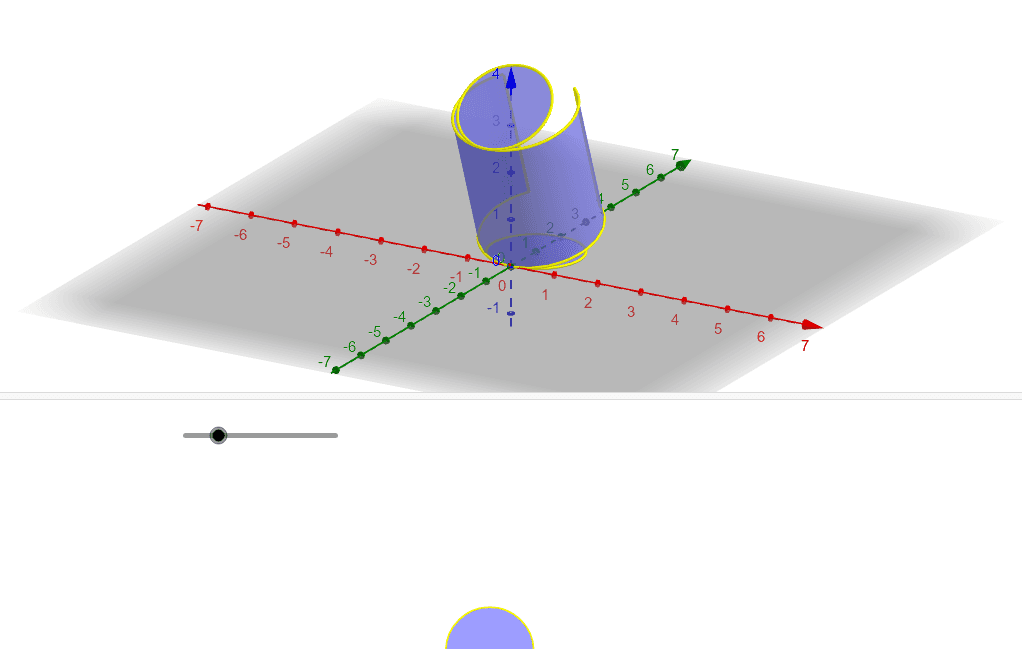
① This example demonstrates the unfolding of a cylinder's surface into a flat net, showing that the lateral surface becomes a rectangle and the two bases become circles. ② Core mathematical concepts include solid geometry, cylinder, net (surface development), surface area decomposition, and geometric transformations such as rotation and translation. ③ Construction highlights: using GeoGebra commands such as Point, Circle, Cylinder, Intersect, Line, OrthogonalLine, Rotate, If, and Segment to build the cylinder and its net, with sliders or parameters controlling the unfolding angle for dynamic visualization. ④ Suitable for middle or high school geometry classes to help students understand the relationship between 3D shapes and their 2D nets, enhancing spatial reasoning and supporting hands-on exploration.
GeoGebra Commands & Parameters
Point(yAxis) → APoint(yAxis) → BCircle(A, B) → cCylinder(c, 3) → b, e, fIntersect(zAxis, e) → C,Line(C, xAxis) → aOrthogonalLine(D, xOyPlane) → gCircle(g, C) → kRotate(Rotate[e, ϕ, a], ϕ, xAxis) → e'Rotate(Rotate[e, ϕ, a], ϕ, xAxis) → dCircle(A, B) → hIf(t < 1, ((r * sin((-θ))), ((r * (1 - cos((-θ)))) * cos(ϕ)) - (3 * sin(ϕ)), (3 * cos(ϕ)) + ((r * (1 - cos((-θ)))) * sin(ϕ))), ((-π), ((-3) * sin(ϕ)), (3 * cos(ϕ)))) → EIf(t < 1, ((r * sin(θ)), ((r * (1 - cos(θ))) * cos(ϕ)) - (3 * sin(ϕ)), (3 * cos(ϕ)) + ((r * (1 - cos(θ))) * sin(ϕ))), (π, ((-3) * sin(ϕ)), (3 * cos(ϕ)))) → FIf(t < 1, ((r * sin((-θ))), ((r * (1 - cos((-θ)))) * cos(ϕ)), ((r * (1 - cos((-θ)))) * sin(ϕ))), (-3.141592653589793, 0, 0)) → GIf(t < 1, ((r * sin(θ)), ((r * (1 - cos(θ))) * cos(ϕ)), ((r * (1 - cos(θ))) * sin(ϕ))), (3.141592653589793, 0, 0)) → HSegment(E, G) → mSegment(F, H) → nLine((0, 1, 0), zAxis) → pCircle(p, B) → qCircle(p, B) → sIf(t < 1, Surface[(r * sin((u * θ))), ((r * (1 - cos((u * θ)))) * cos(ϕ)) - (v * sin(ϕ)), (v * cos(ϕ)) + ((r * (1 - cos((u * θ)))) * sin(ϕ)), u, -1, 1, v, 0, 3], Surface[(π * u), ((-v) * sin(ϕ)), (v * cos(ϕ)), u, -1, 1, v, 0, 3]) → iIf(t < 1, CurveCartesian[(r * sin((u * θ))), ((r * (1 - cos((u * θ)))) * cos(ϕ)), ((r * (1 - cos((u * θ)))) * sin(ϕ)), u, -1, 1], CurveCartesian[(π * u), 0, 0, u, -1, 1]) → lIf(t < 1, CurveCartesian[(r * sin((u * θ))), ((r * (1 - cos((u * θ)))) * cos(ϕ)) - (3 * sin(ϕ)), (3 * cos(ϕ)) + ((r * (1 - cos((u * θ)))) * sin(ϕ)), u, -1, 1], CurveCartesian[(π * u), (-3 * sin(ϕ)), (3 * cos(ϕ)), u, -1, 1]) → j
AI Drawing Prompt Reference
Draw the net of a cylinder, showing the lateral surface as a rectangle and the bases as circles. Start with the cylinder, then unfold its side into a rectangle while keeping the circular bases. Use a slider to control the unfolding angle for dynamic visualization. The image should include the cylinder, a rectangle, and circular bases, with geometric transformations like rotation and translation to achieve the unfolding effect.
The prompt above was compiled from the original drawing commands and is for reference only.