
Napoleon Triangle on Parallelograms
Loading the math board and drawing, please wait…
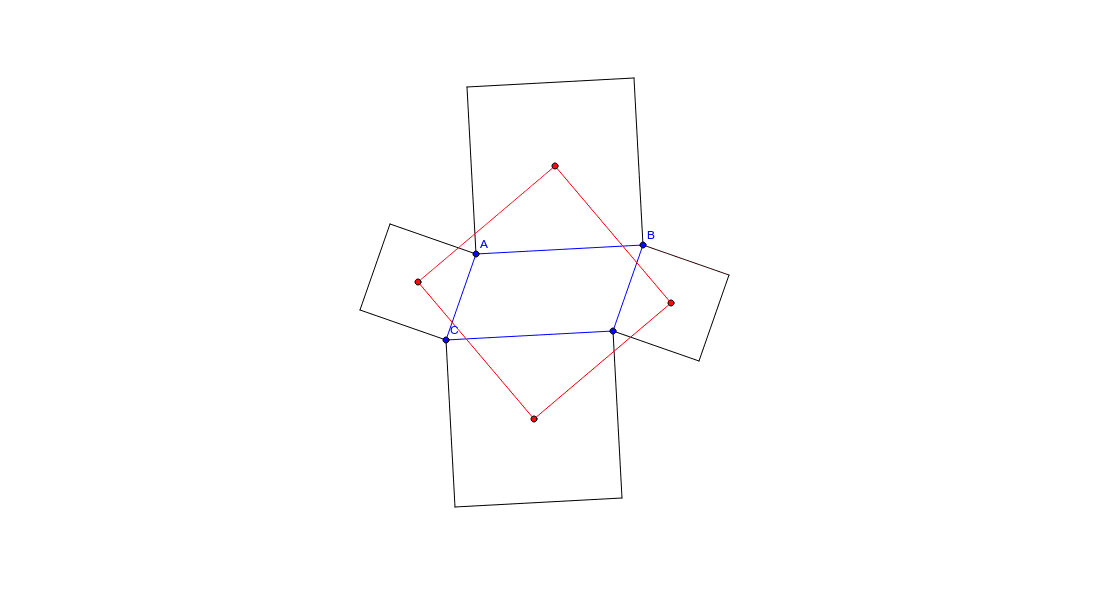
This example demonstrates the construction of Napoleon triangles on parallelograms. Key mathematical concepts include triangles, angles, and trigonometry. Using GeoGebra commands such as Segment, Line, and Circle, dynamic exploration of the properties of Napoleon triangles is possible. Suitable for high school mathematics education, particularly in coordinate geometry and trigonometry.
GeoGebra Commands & Parameters
Segment(A, B) → aLine(C, a) → bCircle(C, Segment[A, B]) → cIntersect(c, b) → D, ESegment(C, E) → dSegment(A, C) → eSegment(E, B) → fOrthogonalLine(A, a) → gOrthogonalLine(B, a) → hCircle(A, Segment[A, B]) → kCircle(B, Segment[A, B]) → pIntersect(k, g) → F, GIntersect(p, h, 2.0) → HSegment(G, H) → iSegment(G, A) → jSegment(H, B) → lSegment(A, H) → mSegment(G, B) → nIntersect(m, n) → IOrthogonalLine(B, f) → qOrthogonalLine(E, f) → rCircle(B, f) → sCircle(E, f) → tIntersect(s, q, 1.0) → JIntersect(t, r, 1.0) → KSegment(J, K) → a_1Segment(B, J) → b_1Segment(E, K) → c_1OrthogonalLine(C, e) → d_1OrthogonalLine(A, e) → e_1Circle(A, C) → f_1Circle(C, A) → g_1Intersect(g_1, d_1, 1.0) → LIntersect(f_1, e_1, 1.0) → MSegment(L, M) → h_1Segment(M, A) → i_1Segment(L, C) → j_1OrthogonalLine(C, d) → k_1OrthogonalLine(E, d) → l_1Circle(C, E) → p_1Circle(E, C) → q_1Intersect(p_1, k_1, 1.0) → NIntersect(q_1, l_1) → O, PSegment(N, O) → m_1Segment(C, N) → n_1Segment(E, O) → r_1Midpoint(L, A) → QMidpoint(B, K) → RMidpoint(C, O) → SSegment(Q, I) → s_1Segment(I, R) → t_1Segment(R, S) → a_2Segment(S, Q) → b_2
AI Drawing Prompt Reference
Draw a parallelogram ABCD, then construct an equilateral triangle on each side with the opposite side as the base. The circumcircles of these equilateral triangles intersect at new points E, F, and G. Connect these new points to form the Napoleon triangle. Pay attention to the construction process of each equilateral triangle and how it affects the shape of the Napoleon triangle.
The prompt above was compiled from the original drawing commands and is for reference only.