
Division of the Circle into n Parts: Bion and Tempier Methods
Loading the math board and drawing, please wait…
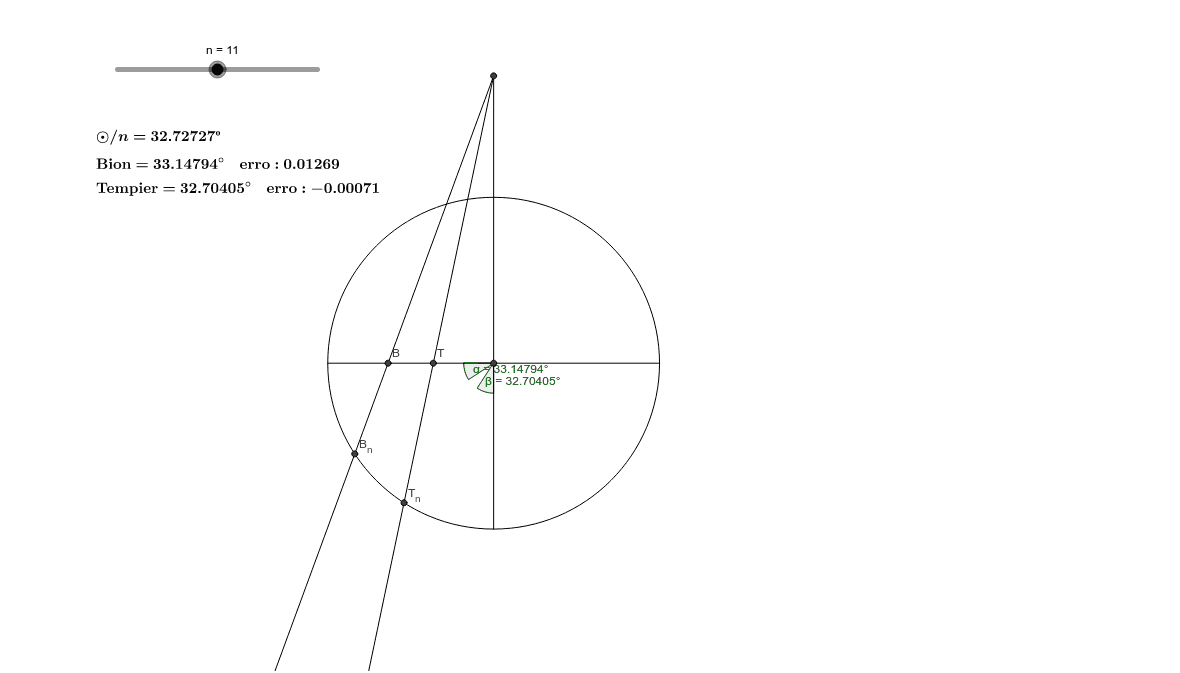
This GeoGebra example demonstrates how to divide a circle into n equal parts using two classical geometric construction methods, those of Bion and Tempier, and compares their accuracy. The core mathematical concepts involve circle division, similar triangles, angle measurement, vectors, trigonometric functions, and numerical error analysis. The construction employs GeoGebra commands such as Intersect, Circle, Ray, Segment, Point, and Angle, with objects including a slider n for the number of parts, key points B_1, center C, auxiliary circle c, ray d, segment e, intersection point T, auxiliary lines f and g, final division points B_n and T_n, error angles α and β, and error values err_b and err_t. By dynamically adjusting n, users can visually inspect how the two methods differ in precision, making it suitable for high school and university students studying geometric construction principles, sources of numerical error, and the use of dynamic mathematics software for verification.
GeoGebra Commands & Parameters
Intersect(xAxis, yAxis) → ACircle(A, B_1) → cIntersect(c, xAxis, 1) → CCircle(C, 4 / n) → dIntersect(d, xAxis, 2) → BCircle(A, 4 / n) → eIntersect(e, xAxis, 1) → TCircle(C, B_1) → fCircle(B_1, C) → gIntersect(f, g, 1) → FRay(F, B) → aRay(F, T) → bIntersect(c, a, 2) → B_nIntersect(c, b, 2) → T_nSegment(C, B_1) → hPoint(c) → DSegment(F, D) → iAngle(C, A, B_n) → αAngle(T_n, A, D) → β
AI Drawing Prompt Reference
Draw a dynamic circle division graphic. The center of the circle is point C. Users can adjust the number of parts n via a slider. The construction involves an auxiliary circle c and a ray d to generate initial points B and T. Then, using similar triangles and angle measurement, auxiliary lines f and g are constructed to find final division points B_n and T_n. Additionally, mark error angles α and β, and error values err_b and err_t. Users can visually observe the differences in precision between the two methods.
The prompt above was compiled from the original drawing commands and is for reference only.