
Naming Congruent and Similar Triangles
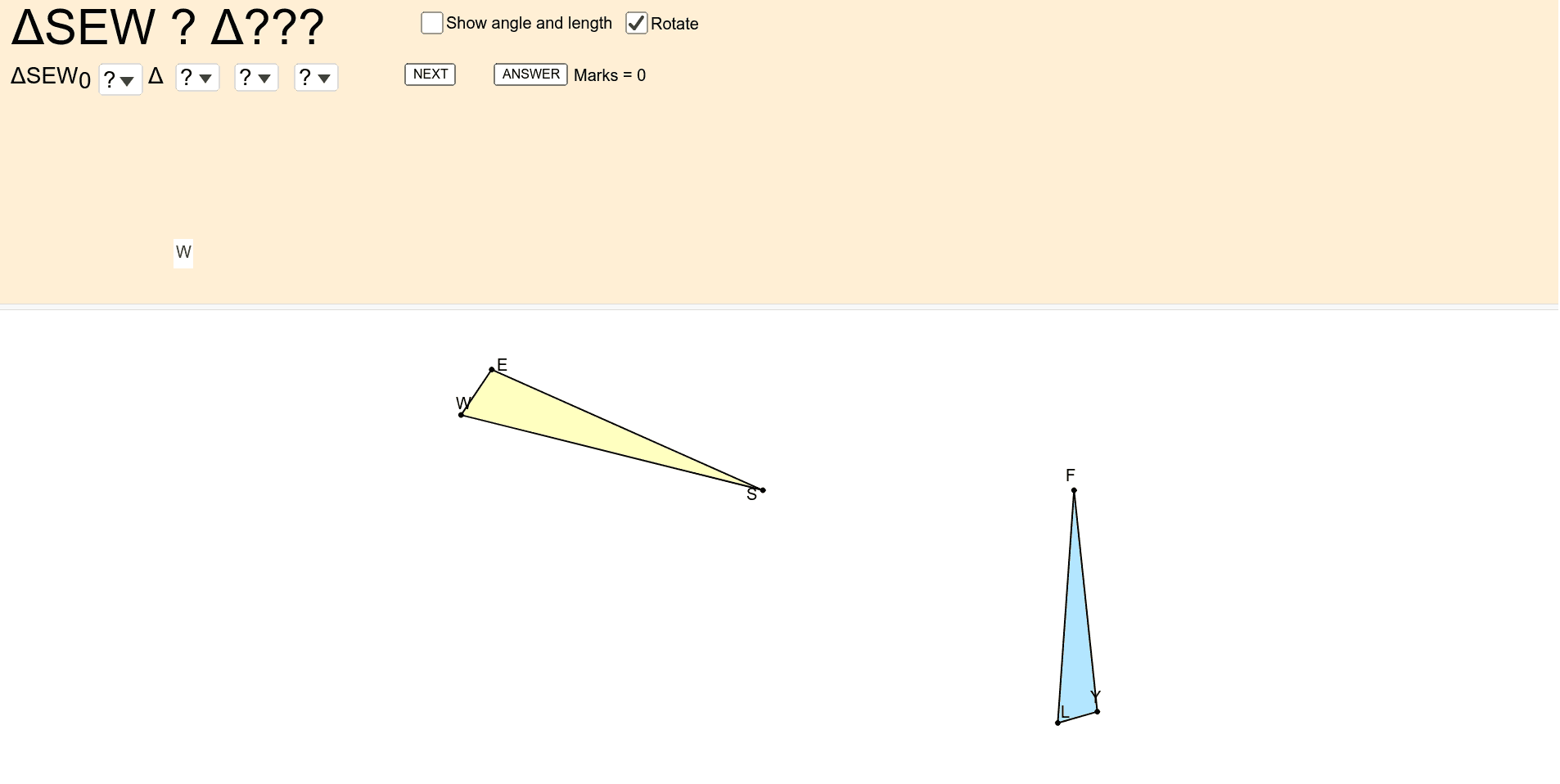
Loading the math board and drawing, please wait…
This example demonstrates how to dynamically visualize and name congruent and similar triangles using GeoGebra. It covers core concepts like SSS, SAS, ASA, AAS for congruence and AA, SAS, SSS for similarity. Key GeoGebra commands and objects used include Sequence, RandomElement, Rotate, Line, Intersect, Circle, If, Max, Polygon, Min, Shuffle, Angle, Take, Append to generate and transform triangles. Suitable for middle school and above mathematics education for geometric construction and theorem verification.
GeoGebra Commands & Parameters
Sequence(30° + ((i * 10))°, i, 0, 12) → listAlphaRandomElement(listAlpha) → αSequence(((i * 10))°, i, 1, (180 - α / °) / 10 - 1) → listBetaRandomElement(listBeta) → βRandomElement({0.75, 1, 1.25}) → kRotate(A, β, O) → A'Line(O, A') → LineOA'Rotate(O, (-α), A) → O'Line(A, O') → LineAO'Intersect(LineOA', LineAO') → BCircle(O'', (Distance[O, B] * k)) → cRotate(Dilate[Translate[A, Vector[O, O'']], k, O''], If[rotate, theta, 0°], O'') → A''Circle(A'', (Distance[A, B] * k)) → dIntersect(c, d, 1) → B''1Intersect(c, d, 2) → B''2If(reflect, B''1, B''2) → B''Max({Distance[A, B], Distance[A, O], Distance[O, B]}) → maxLengthMax({x(O), x(A), x(B), x(O''), x(A''), x(B'')}) → maxXPolygon(O, A, B) → poly1, b_1, c_1, a_1Min({x(O), x(A), x(B), x(O''), x(A''), x(B'')}) → minXMin({y(O), y(A), y(B), y(O''), y(A''), y(B'')}) → minYMax({y(O), y(A), y(B), y(O''), y(A''), y(B'')}) → maxYShuffle({"D", "E", "F", "G", "H", "J", "K", "L", "M", "N", "P", "Q", "R", "S", "T", "V", "W", "X", "Y"}) → listLetterAngle(poly1) → angleO, angleA, angleBPolygon(B'', O'', A'') → poly2, a_2, b_2, c_2Angle(poly2) → angleB'', angleO'', angleA''Take(listLetter, 1, 3) → listQuestionAppend("?", Take[listLetter, 4, 6]) → listAnswer1Append("?", Take[listLetter, 4, 6]) → listAnswer2Append("?", Take[listLetter, 4, 6]) → listAnswer3If(SelectedIndex[listAnswer1] ≟ 2, angleO'', If[SelectedIndex[listAnswer1] ≟ 3, angleA'', If[SelectedIndex[listAnswer1] ≟ 4, angleB'', 0°]]) → ans1If(SelectedIndex[listAnswer2] ≟ 2, angleO'', If[SelectedIndex[listAnswer2] ≟ 3, angleA'', If[SelectedIndex[listAnswer2] ≟ 4, angleB'', 0°]]) → ans2If(SelectedIndex[listAnswer3] ≟ 2, angleO'', If[SelectedIndex[listAnswer3] ≟ 3, angleA'', If[SelectedIndex[listAnswer3] ≟ 4, angleB'', 0°]]) → ans3