
Multiplication Frame and Algebraic Factorization
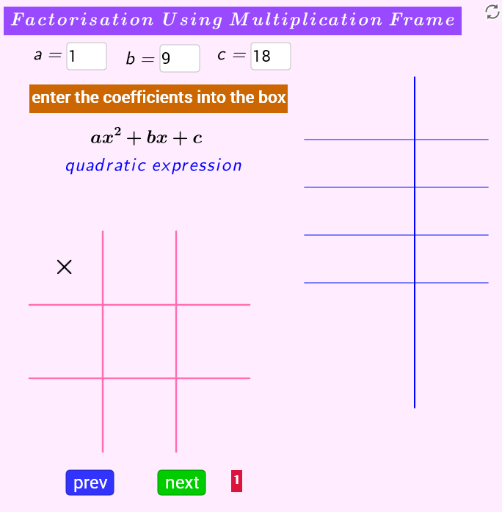
Loading the math board and drawing, please wait…
① This interactive GeoGebra example demonstrates algebraic factorization through a visual 'multiplication frame' where users input polynomials and observe their factor decomposition. ② Core math concepts include algebraic factorization, distributive law, divisor lists, polynomial factors, function graphs, and symmetry. ③ Construction uses commands such as DivisorsList, Factors, Sequence, IndexOf, Element, Textfield, Point, Segment, Text, Vector, and Polygon; objects include input boxes (InputBox1-3), factor lists (listfactor1, list9_.factors2), midlines (list7_.midline), and multiple points, segments, and text labels for dynamic interaction. ④ Suitable for middle and high school algebra classes, factorization practice, and math lab activities, helping students grasp the geometric and algebraic meaning of factorization.
GeoGebra Commands & Parameters
DivisorsList(d_.2) → listDivisorsFactors(d_.2) →Sequence(Element[list2, p] + Element[list3, p], p, 1, d) → list4IndexOf(b, list4) → poointElement(list2, pooint) → p_.1Element(list3, pooint) → p_.2Textfield(a) → InputBox1Textfield(b) → InputBox2Textfield(c) → InputBox3Sequence((4.5, 3 - (p * 1.3)), p, 1, d) → list5_.factors1Sequence((7, 6 - (p * 1.8)), p, 1, d + 3) → list7_.midlinePoint(list7_.midline) → ASegment(C, F) → jSegment(G, H) → kSegment(I, J) → lSegment(K, L) → mSequence(Text[Element[list2, p], Element[list5_.factors1, p]], p, 1, d) → listfactor1Sequence((5.5, 3 - (p * 1.3)), p, 1, d) → list9_.factors2Sequence(Text[Element[list3, p], Element[list9_.factors2, p]], p, 1, d) → listFactor2Sequence((7.5, 3 - (p * 1.3)), p, 1, d) → list11_.sumSequence(Text[Element[list4, p], Element[list11_.sum, p]], p, 1, d) → listSumSegment(Element[list7_.midline, 1], Element[list7_.midline, d + 2]) → iSequence((3.8, 3 - (p * 1.3)), p, 1, d) → list13_.brkt1Text("[", Element[list13_.brkt1, pooint]) → text22Sequence((9, 3 - (p * 1.3)), p, 1, d) → list14_.brkt2Text("]", Element[list14_.brkt2, pooint]) → text21Element(list13_.brkt1, pooint) → PKVector(PK, A_1) → wVector(PK, B_1) → nPolygon(U, V, W, Z) → poly1, u, v, w_1, z_1Polygon(C_1, D_1, E_1, F_1) → poly2, c_1, d_1, e_1, f_2Polygon(G_1, H_1, I_1, J_1) → poly3, g_2, h_2, i_1, j_1Polygon(O_1, P_1, Q_1, R_1) → poly5, o_1, p_2, q_1, r_1Polygon(S_1, T_1, U_1, V_1) → poly6, s_1, t_1, u_1, v_1Polygon(K_1, L_1, M_1, N_1) → poly4, k_1, l_1, m_1, n_1Sequence(Segment[(4, 3.8 - (p * 1.3)), (9, 3.8 - (p * 1.3))], p, 1, d + 1) → listSegment