
More Limits Requiring Algebraic Manipulation
Loading the math board and drawing, please wait…
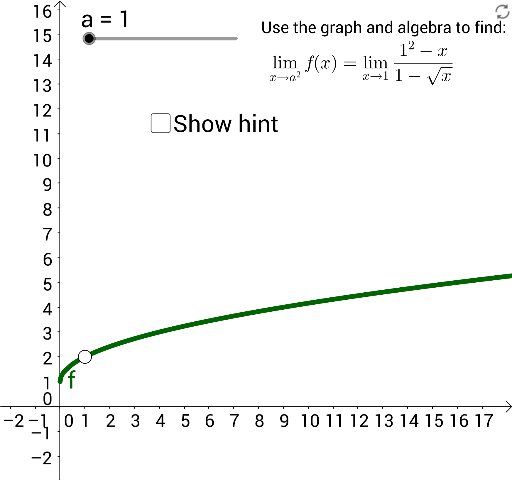
This GeoGebra example demonstrates how to evaluate complex limits by applying algebraic manipulation techniques such as factoring, rationalization, and simplification. It visually presents the limiting behavior of functions involving polynomials and logarithms, while also incorporating concepts like random variables and centroid/barycenter, linking calculus with probability and geometry. The construction uses objects a, f, text2, text3, c, b, text1, and A, likely defining a function f(x) with parameters and text labels to annotate steps or results. This resource is ideal for high school or early college students learning calculus, helping them master algebraic strategies for limit evaluation, and serves as an interactive tool for classroom demonstrations or self-study.
GeoGebra Commands & Parameters
Numeric a(1)f(x) = (a^(2) - x) / (a - sqrt(x))Boolean c(false)a^(2)(a^(2), (2 * a))
AI Drawing Prompt Reference
Create a mathematical graph illustrating a limit requiring algebraic manipulation. Start with a parameter value, then plot a function defined as the difference between the square of the parameter and the variable, divided by the parameter minus the square root of the variable. Annotate the limiting behavior at a specific point, and display the value of the parameter squared. Also mark a key point on the plane with x-coordinate equal to the parameter squared and y-coordinate equal to twice the parameter. Include text labels to briefly explain the algebraic simplification steps or results, aiding in understanding the limit evaluation.
The prompt above was compiled from the original drawing commands and is for reference only.