
Mondrian 3: Geometric Partitioning Driven by Algebraic Constraints
Loading the math board and drawing, please wait…
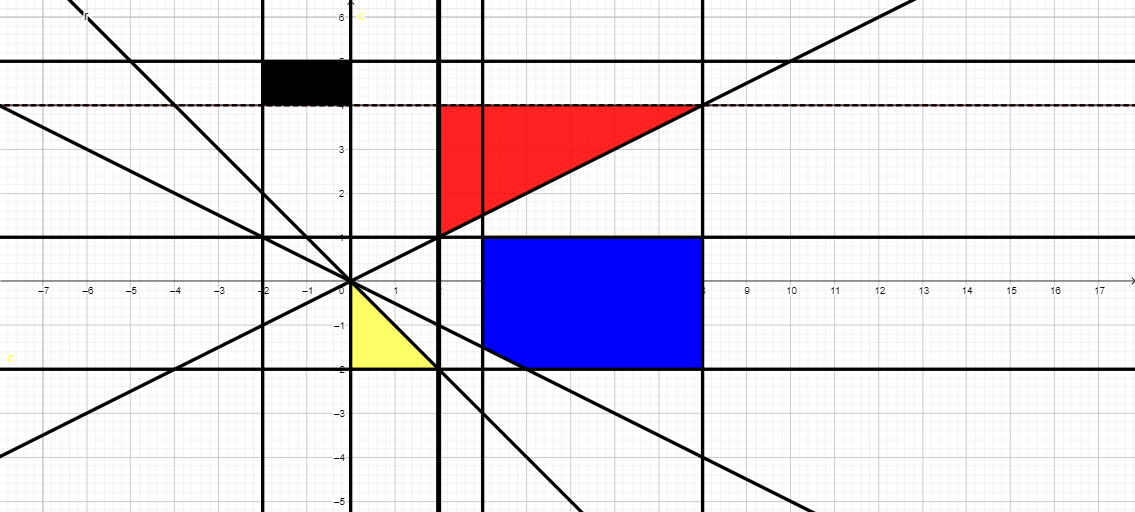
This GeoGebra example demonstrates a Mondrian-style, partitioned geometric composition, showing how algebraic relationships can be turned into an interactive visual structure. It highlights core ideas such as geometric construction, linear equations and linear optimization concepts (constraints shaping the partition), and proportional/percentage reasoning, along with inequality-based thinking that can determine feasible shapes and regions. In the construction, multiple key objects are defined—points b, a, c, d, and parameters p, q, r—together with several equation/constraint objects ec1 through ec6. Additional computed objects (f, g, h and ec3–ec6) indicate that the final layout is produced by solving or enforcing these relations, then rendering the corresponding geometric elements. Suitable for middle/high school through early university learners, especially for lessons on geometric construction, linear constraints, and model-to-visualization workflows.
GeoGebra Commands & Parameters
b(x, y) = x < (2 * y) ∧ x > 2 ∧ y < 4x = (2 * y)x = 2y = 4a(x, y) = x > 3 ∧ y < 1 ∧ y > (-0.5 * x) ∧ y > -2 ∧ x < 8y = 1x = 3y = (-0.5 * x)c(x, y) = x < (-y) ∧ x > 0 ∧ y > -2x = 0y = 5d(x, y) = y < 5 ∧ y > 4 ∧ x < 0 ∧ x > -2x = -2y = -2y = (-x)x = 8
AI Drawing Prompt Reference
Create a Mondrian-like partitioned coordinate-plane composition by drawing several boundary lines: the vertical lines x=2, x=3, x=0, x=-2, the horizontal lines y=4, y=1, y=5, y=-2, and the diagonal lines x=2y and x=-y. Then indicate four feasible regions defined by inequality constraints for points b, a, c, and d: b satisfies x<2y, x>2, and y<4; a satisfies x>3, y<1, y>-0.5x, y>-2, and x<8; c satisfies x<-y, x>0, and y>-2; d satisfies y<5, y>4, x<0, and x>-2. Render the resulting region boundaries and their intersections in a single unified partition to show how algebraic constraints shape the layout.
The prompt above was compiled from the original drawing commands and is for reference only.