
Modes of Vibration of a Fixed String (Standing Waves)
Loading the math board and drawing, please wait…
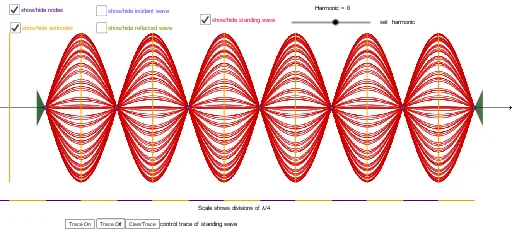
This GeoGebra example dynamically illustrates the vibration modes of a string fixed at both ends, showing standing wave patterns for different harmonics. It demonstrates how the displacement of the string varies with harmonic number, highlighting nodes and antinodes. Core mathematical concepts include standing waves, harmonics, the relationship between frequency and wavelength (f = nv/(2L)), superposition of sine functions, and the spatial distribution of nodes and antinodes. The construction uses the Sequence command to generate multiple harmonic components, Polygon to draw the string outline, sliders (e.g., nharm) to control the harmonic order, and boolean variables (boolnodes, boolantinodes, etc.) to toggle the display of nodes, antinodes, incident, reflected, and resultant waves. Suitable for high school or introductory university physics courses on wave motion, as well as mathematics classes exploring trigonometric functions and graphing.
GeoGebra Commands & Parameters
Sequence(((-((2 * n) + 1)) * λ / 4), n, 0, 10) → anSequence(((-n) * λ / 2), n, 0, 10) → noSequence(Segment[(Element[an, n], -2.5), (Element[no, n + 1], -2.5)], n, 1, 10) → Scale1Sequence(Segment[(Element[no, n], -2.5), (Element[an, n], -2.5)], n, 1, 10) → ScaleSequence(Segment[Element[an1, n], Element[an2, n]], n, 1, 10) → AntinodesPolygon(F, G, E) → t1, e, f_1, gPolygon(A, B, C) → t2, c, a, b
AI Drawing Prompt Reference
Draw a horizontal string fixed at both ends, showing its vibration modes as standing waves. Below the string, place a ruler with evenly spaced tick marks, and mark the positions of nodes and antinodes. Use a slider to control the harmonic number, and toggle the display of incident, reflected, and resultant waves. Distinguish nodes and antinodes with different colors or line styles, and outline the string's shape. Include multiple harmonic components, each as a sine curve, which superpose to form the standing wave pattern. The layout should be clear for observing displacement variations and the distribution of nodes and antinodes across harmonics.
The prompt above was compiled from the original drawing commands and is for reference only.