
Measuring with Unit Cubes
Loading the math board and drawing, please wait…
In collections
Wiederholung: Flächen- und Raummaße
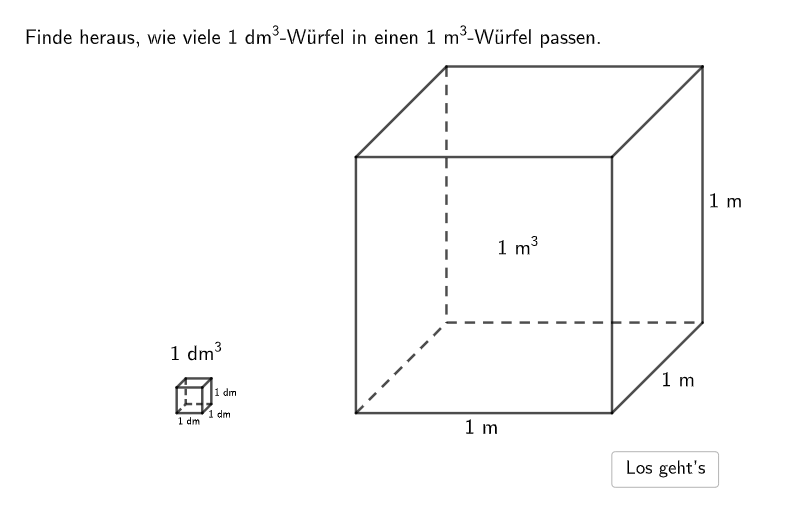
This example demonstrates how to use unit cubes for volume measurement. Key mathematical concepts include unit conversion and volume calculation. Through the GeoGebra commands in the construction summary, students can learn how to perform volume conversions using unit cubes. Suitable for 5-6 grade students to learn about measuring and comparing volumes.
GeoGebra Commands & Parameters
If(step ≟ 5 ∨ step ≟ 6, input ≟ 10, If[step ≟ 8 ∨ step ≟ 9, input ≟ 100, If[step ≟ 11 ∨ step ≟ 12, input ≟ 1000]]) → correctSequence(Random[1, 10], i, 1, 10) → randomNumbers, {1, 1, 2, 1, 4, 4, 4, 6, 10, 9}Element(randomNumbers, Mod[questionCount, Length[randomNumbers]] + 1) → randomNumberTextfield(input) → inputBoxSegment(A, B) → abSegment(B, C) → bcSegment(C, D) → cdSegment(D, A) → adSegment(E, F) → efSegment(F, G) → fgSegment(G, H) → ghSegment(H, E) → ehSegment(A, E) → aeSegment(B, F) → bfSegment(C, G) → cgSegment(D, H) → dhSequence(Sequence[Polygon[A + (i, j), A + (i, j) + (cubeLength / 10, 0), A + (i, j) + (cubeLength / 10, cubeLength / 10), A + (i, j) + (0, cubeLength / 10)], i, 0, cubesHorizontal - 1], j, 0, cubesVertical - 1) → cubesAB, {{1}}Sequence(Sequence[Polygon[A + (cubesHorizontal, j) + ((i * cubeDepthCatheters / 10), (i * cubeDepthCatheters / 10)), A + (cubesHorizontal, j) + ((i * cubeDepthCatheters / 10), (i * cubeDepthCatheters / 10)) + (cubeDepthCatheters / 10, cubeDepthCatheters / 10), A + (cubesHorizontal, j) + ((i * cubeDepthCatheters / 10), (i * cubeDepthCatheters / 10)) + (cubeDepthCatheters / 10, cubeDepthCatheters / 10 + cubeLength / 10), A + (cubesHorizontal, j) + ((i * cubeDepthCatheters / 10), (i * cubeDepthCatheters / 10)) + (0, cubeLength / 10)], i, 0, cubesDepth - 1], j, 0, cubesVertical - 1) → cubesBF, {{0.35355339059327373}}Segment(BSmall, CSmall) → bcSmallSegment(CSmall, DSmall) → cdSmallSegment(DSmall, ASmall) → adSmallSegment(ESmall, FSmall) → efSmallSegment(FSmall, GSmall) → fgSmallSegment(GSmall, HSmall) → ghSmallSegment(HSmall, ESmall) → ehSmallSegment(ASmall, ESmall) → aeSmallSegment(BSmall, FSmall) → bfSmallSegment(CSmall, GSmall) → cgSmallSegment(DSmall, HSmall) → dhSmallSequence(Sequence[Polygon[A + (i, cubesVertical) + ((j * cubeDepthCatheters / 10), (j * cubeDepthCatheters / 10)), A + (i, cubesVertical) + ((j * cubeDepthCatheters / 10), (j * cubeDepthCatheters / 10)) + (cubeLength / 10, 0), A + (i, cubesVertical) + ((j * cubeDepthCatheters / 10), (j * cubeDepthCatheters / 10)) + (cubeLength / 10 + cubeDepthCatheters / 10, cubeDepthCatheters / 10), A + (i, cubesVertical) + ((j * cubeDepthCatheters / 10), (j * cubeDepthCatheters / 10)) + (cubeDepthCatheters / 10, cubeDepthCatheters / 10)], i, 0, cubesHorizontal - 1], j, 0, cubesDepth - 1) → cubesAD, {{0.35355339059327373}}Sequence(Sequence[Polygon[ASmall + (i, j), ASmall + (i, j) + (cubeLength / 10, 0), ASmall + (i, j) + (cubeLength / 10, cubeLength / 10), ASmall + (i, j) + (0, cubeLength / 10)], i, 0, cubesHorizontal - 1], j, 0, cubesVertical - 1) → cubeABSmall, {{1}}Sequence(Sequence[Polygon[ASmall + (cubesHorizontal, j) + ((i * cubeDepthCatheters / 10), (i * cubeDepthCatheters / 10)), ASmall + (cubesHorizontal, j) + ((i * cubeDepthCatheters / 10), (i * cubeDepthCatheters / 10)) + (cubeDepthCatheters / 10, cubeDepthCatheters / 10), ASmall + (cubesHorizontal, j) + ((i * cubeDepthCatheters / 10), (i * cubeDepthCatheters / 10)) + (cubeDepthCatheters / 10, cubeDepthCatheters / 10 + cubeLength / 10), ASmall + (cubesHorizontal, j) + ((i * cubeDepthCatheters / 10), (i * cubeDepthCatheters / 10)) + (0, cubeLength / 10)], i, 0, cubesDepth - 1], j, 0, cubesVertical - 1) → cubeBFSmall, {{0.35355339059327395}}Sequence(Sequence[Polygon[ASmall + (i, cubesVertical) + ((j * cubeDepthCatheters / 10), (j * cubeDepthCatheters / 10)), ASmall + (i, cubesVertical) + ((j * cubeDepthCatheters / 10), (j * cubeDepthCatheters / 10)) + (cubeLength / 10, 0), ASmall + (i, cubesVertical) + ((j * cubeDepthCatheters / 10), (j * cubeDepthCatheters / 10)) + (cubeLength / 10 + cubeDepthCatheters / 10, cubeDepthCatheters / 10), ASmall + (i, cubesVertical) + ((j * cubeDepthCatheters / 10), (j * cubeDepthCatheters / 10)) + (cubeDepthCatheters / 10, cubeDepthCatheters / 10)], i, 0, cubesHorizontal - 1], j, 0, cubesDepth - 1) → cubeADSmall, {{0.3535533905932744}}Segment(meterA, meterB) → meterSegment(ASmall, BSmall) → abSmallSegment(BSmall_{1}, CSmall_{1}) → bcSmall_{1}Segment(CSmall_{1}, DSmall_{1}) → cdSmall_{1}Segment(DSmall_{1}, ASmall_{1}) → adSmall_{1}Segment(ESmall_{1}, FSmall_{1}) → efSmall_{1}Segment(FSmall_{1}, GSmall_{1}) → fgSmall_{1}Segment(GSmall_{1}, HSmall_{1}) → ghSmall_{1}Segment(HSmall_{1}, ESmall_{1}) → ehSmall_{1}Segment(ASmall_{1}, ESmall_{1}) → aeSmall_{1}Segment(BSmall_{1}, FSmall_{1}) → bfSmall_{1}Segment(CSmall_{1}, GSmall_{1}) → cgSmall_{1}Segment(DSmall_{1}, HSmall_{1}) → dhSmall_{1}Segment(ASmall_{1}, BSmall_{1}) → abSmall_{1}Segment((-11, 0), (-11.05, 0)) → cubeCM
AI Drawing Prompt Reference
Draw a unit cube volume measurement example, including multiple cubes and measuring lines. The size of the cubes can be adjusted according to the user's input value. The example includes 3D cubes, measuring lines, and labels. The AI drawing tool should generate the corresponding cubes and measuring lines based on the user's input value, illustrating the process of measuring the volume of the cubes.
The prompt above was compiled from the original drawing commands and is for reference only.