
Maximize the Area of a Rectangle under a Parabola
Loading the math board and drawing, please wait…
In collections
Calculus Applets- Derivatives
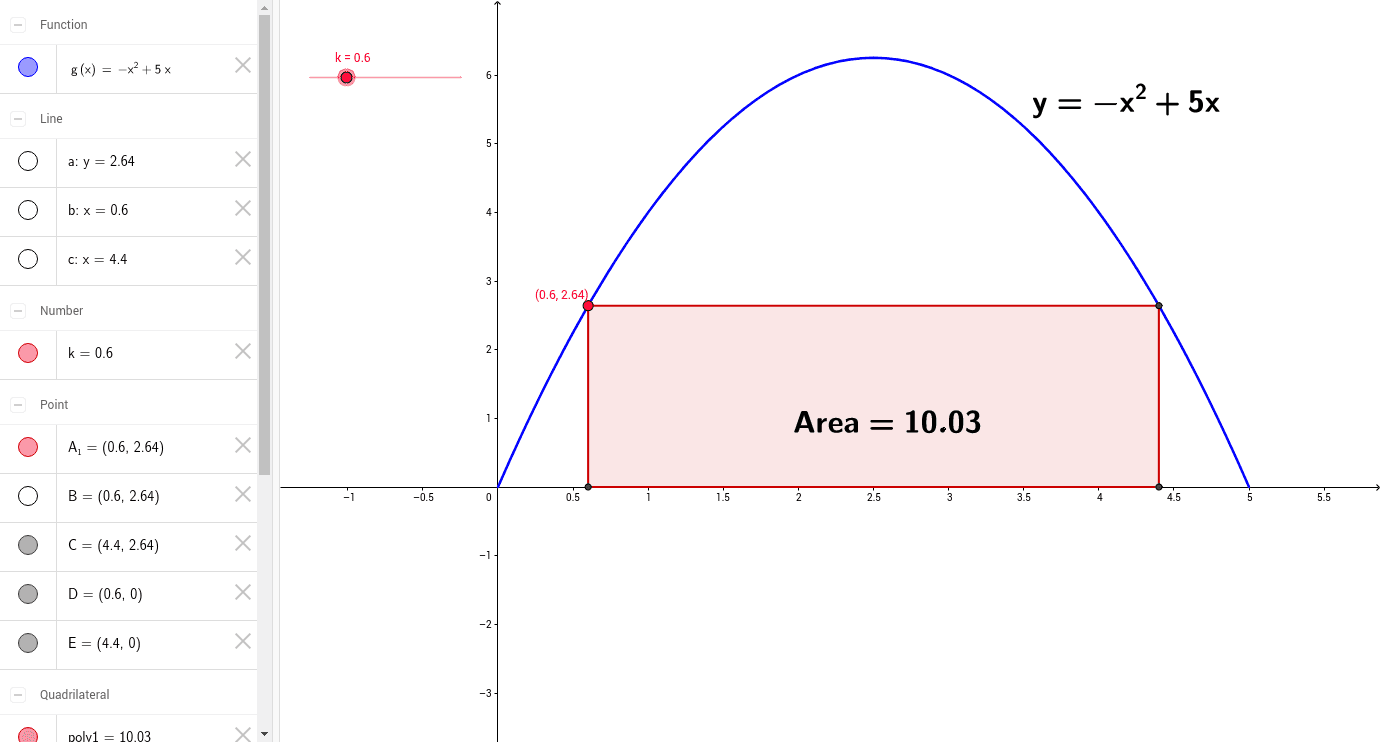
This example demonstrates how to find the maximum area of a rectangle under the parabola y=-x^2+5x. Key mathematical concepts include derivatives and optimization. By constructing the two sides of the rectangle to be tangent to the parabola, using intersection points and tangency points to form the rectangle, and applying commands such as function, line, orthogonal line, intersect, and polygon. Suitable for high school mathematics education or learning optimization problems.
GeoGebra Commands & Parameters
Function(-x^(2) + 5 * x, 0, 5) → gLine(A_1, xAxis) → aOrthogonalLine(A_1, xAxis) → bIntersect(g, a) → B, COrthogonalLine(C, xAxis) → cIntersect(b, xAxis) → DIntersect(c, xAxis) → EPolygon(A_1, D, E, C) → poly1, a_1, d, e, c_1
AI Drawing Prompt Reference
Draw the parabola y=-x^2+5x, then choose any point A on the x-axis, draw a perpendicular line a from A to the x-axis, draw a line b perpendicular to a that is tangent to the parabola at point C, draw a line c perpendicular to the x-axis through C, and find the intersection of b and c at point D, and the intersection of c and the x-axis at point E. Finally, use points A, D, E, and C to draw a quadrilateral.
The prompt above was compiled from the original drawing commands and is for reference only.