
Max Bill Geometric Construction by Mihaela Git (3)
Loading the math board and drawing, please wait…
In collections
Paintings modeled in Geogebra
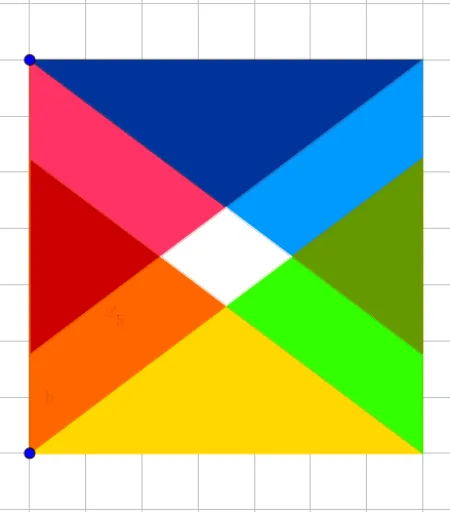
This example demonstrates the construction of Max Bill's geometric shapes using GeoGebra, showcasing the combination of polygons, trapezoids, and triangles. It involves core mathematical concepts such as polygon construction, similarity transformations, intersection calculations, trigonometric functions, and arithmetic mean analysis. Key construction steps utilize GeoGebra commands like Polygon, Dilate, and Intersect, along with points, lines, and polygons. Suitable for high school and above students for understanding geometric transformations and comprehensive applications.
GeoGebra Commands & Parameters
Polygon(A, B, 4) → poligon1, f, g, h, i, C, DDilate(D, 1 / 4, C) → D'Dilate(D, 2 / 4, C) → D'_1Dilate(D, 3 / 4, C) → D'_2Dilate(A, 1 / 4, B) → A'Dilate(A, 2 / 4, B) → A'_1Dilate(A, 3 / 4, B) → A'_2Dilate(D, 1 / 4, A) → D'_3Dilate(D, 2 / 4, A) → D'_4Dilate(D, 3 / 4, A) → D'_5Dilate(C, 1 / 4, B) → C'Dilate(B, 1 / 4, C) → B'Dilate(C, 2 / 4, B) → C'_1Polygon(D, D'_2, B, A') → q1, d, d'_2, b, a'Polygon(D', A, A'_2, C) → q2, d', a, a'_2, cIntersect(a', d') → EPolygon(D, E, A) → t1, a_1, d_1, eIntersect(d'_2, d') → FPolygon(D'_2, F, D') → t2, d'_1, d'_3, f_1Intersect(d'_2, a'_2) → GPolygon(C, G, B) → t3, b_1, c_1, g_1Intersect(a', a'_2) → HPolygon(A'_2, H, A') → t4, a'_1, a'_3, h_1Polygon(H, A'_2, A') → t5, a'_4, h_2, a'_5Polygon(A', H, G, B) → q3, a'_6, h_3, g_2, b_2Polygon(A, E, H, A'_2) → q4, a_2, e_1, h_4, a'_7Polygon(A, E, D) → t6, d_2, a_3, e_2Polygon(E, F, D'_2, D) → q5, e_3, f_2, d'_4, d_3Polygon(F, D'_2, D') → t7, d'_5, f_3, d'_6Polygon(G, F, D', C) → q6, g_3, f_4, d'_7, c_2Polygon(E, F, G, H) → q7, e_4, f_5, g_4, h_5
AI Drawing Prompt Reference
Create a complex geometric shape composed of multiple polygons, trapezoids, and triangles, demonstrating the use of similarity transformations, intersection calculations, and trigonometric functions. Start by constructing a quadrilateral, then scale one of its vertices by 1/4, 2/4, and 3/4 to generate multiple scaled points. Use these points to form several trapezoids and triangles, refining the shape through intersections to create a nested and overlapping arrangement of polygons.
The prompt above was compiled from the original drawing commands and is for reference only.