
Mathematical Modeling of the Rubber Pencil Illusion
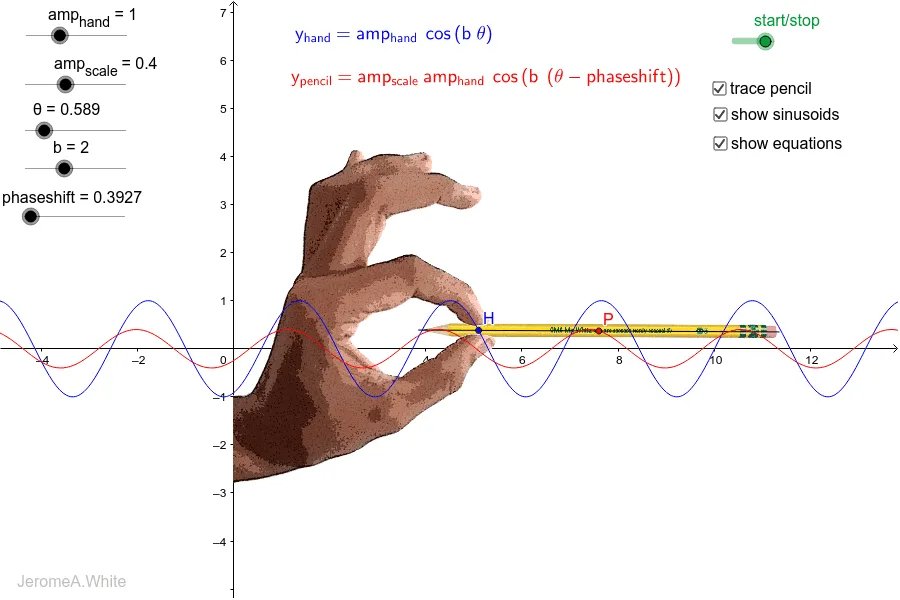
This applet provides a mathematical model of the famous Rubber Pencil Illusion, a well-known visual phenomenon where a pencil held between two fingers appears to bend and wobble when shaken rapidly. The applet uses trigonometric functions, parametric equations, and geometric transformations to simulate the visual deformation that creates this compelling optical effect. Users can interact with the simulation through adjustable sliders for amplitude, phase, frequency, and speed, allowing them to explore how each parameter influences the appearance of the pencil. By manipulating these variables, students can observe firsthand how sinusoidal curves and motion trajectories combine to produce the illusion of a flexible, bending object. The demonstration bridges the gap between abstract mathematical concepts and tangible visual experience, making it an effective teaching tool for trigonometry and parametric modeling. Students benefit by gaining an intuitive understanding of how periodic functions describe real-world motion and perception, seeing directly how phase shifts alter the shape of a wave, how amplitude controls the extent of the perceived deformation, and how frequency and speed affect the realism of the motion. This interactive exploration reinforces key concepts in precalculus and calculus courses while engaging learners through an unexpected and memorable application of mathematics to human vision.
In collections
My First Picture Book: GeoGebra Collection
Loading the math board and drawing, please wait…