
Loci on the Argand Plane 1
Loading the math board and drawing, please wait…
In collections
Complex number multiplication
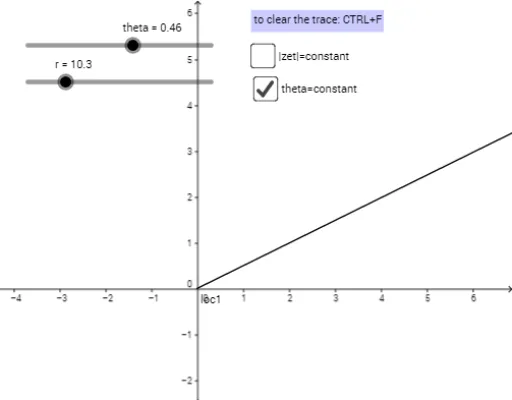
This example demonstrates the construction of loci on the Argand plane using polar coordinates. It involves core mathematical concepts such as complex numbers, polar coordinates, locus equations, and trigonometric functions. The construction uses GeoGebra commands like Locus with objects including theta, r, zet, loc1, loc2, a, b, and text1. It is suitable for high school mathematics education, helping students understand the relationship between complex numbers and loci, as well as parametric graphing techniques.
GeoGebra Commands & Parameters
Locus(zet, r) → loc1Locus(zet, theta) → loc2
AI Drawing Prompt Reference
On the Argand plane, construct two loci using polar coordinates. Start with a complex point whose position depends on a radial distance and an angle. Then, generate one locus by varying the radial distance while keeping the angle fixed, and another by varying the angle while keeping the radial distance fixed. The resulting graph should show the coordinate axes, the origin, and these two curves, illustrating how the complex number's modulus and argument trace out different paths. Include labels for the curves and relevant mathematical expressions to clarify the relationship between complex numbers and their loci.
The prompt above was compiled from the original drawing commands and is for reference only.