
Linear Programming & Solid Geometry: Translation and Congruence in Cubes
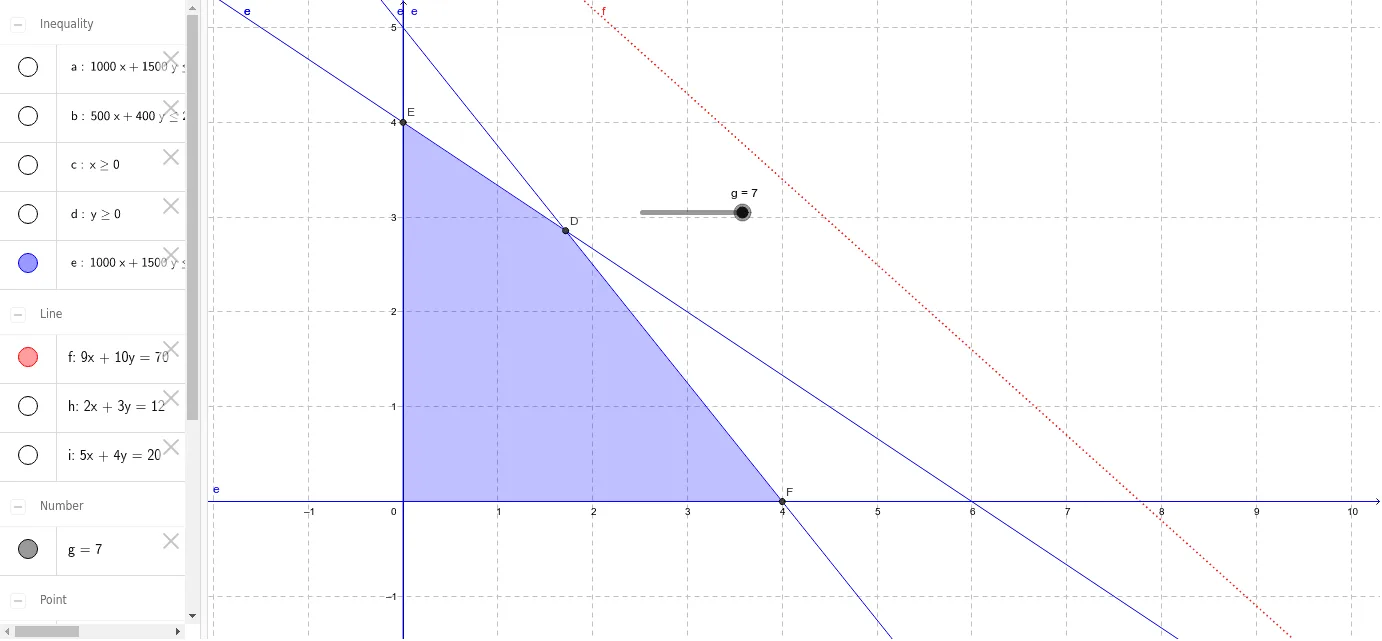
This GeoGebra applet explores the intersection of linear programming and solid geometry at the Senior Year 2 level, focusing on translation and congruence relationships within cubes and prisms. Students interact with a three-dimensional workspace where the Point and Intersect commands are used to construct critical points and intersection lines inside geometric solids. Through dynamic manipulation, learners can observe how planes intersect to form edges, how individual edges translate through space, and how congruent prisms maintain their spatial relationships under transformation.
The applet addresses several key pedagogical objectives. First, it reinforces the construction techniques essential to solid geometry: identifying where two faces meet, determining the line of intersection between non-parallel planes, and recognizing when translated edges remain parallel and equal in length. Second, it connects these spatial reasoning skills to linear programming concepts by framing optimization problems within three-dimensional boundaries, showing students that the feasible region of a linear program can be visualized as the intersection of half-spaces in 3D space.
A central feature is the precise construction of multiple intersection lines across several faces simultaneously. As students drag vertices or adjust parameters, they witness in real time how the entire structure responds while preserving congruence and translation properties. This dynamic feedback helps build intuition about invariant relationships in solid geometry, such as the fact that corresponding edges of congruent prisms remain parallel and equal after any rigid translation.
The applet is particularly valuable for high school mathematics instruction because it bridges abstract algebraic reasoning with concrete geometric visualization. Teachers can use it to demonstrate proofs involving parallel planes, to illustrate the connection between linear constraints and polyhedral feasible regions, and to guide students through multi-step construction problems that require careful attention to spatial relationships. By combining interactive exploration with rigorous geometric reasoning, this tool supports deeper understanding of both the computational and visual dimensions of solid geometry and linear programming.
In collections
High School Math: Grade 11, Semester 1
Loading the math board and drawing, please wait…