
Line of Symmetry Activity
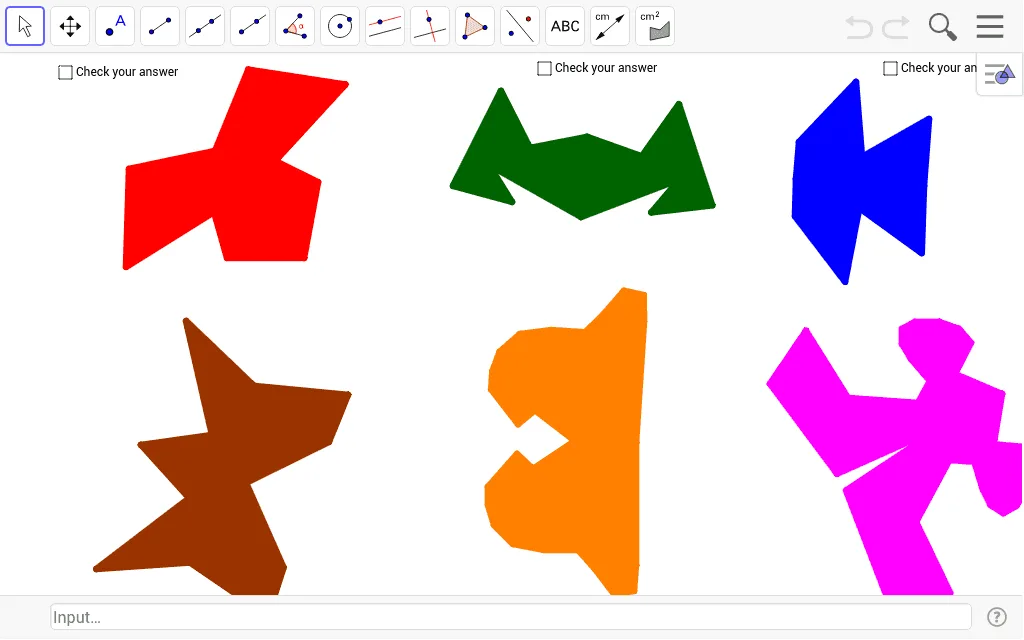
Loading the math board and drawing, please wait…
This example demonstrates the construction of symmetry axes and mirror transformations for polygons. It involves core math concepts like symmetry, incircle or inscribed circle, ratios, linear regression, and exponential functions. The construction uses GeoGebra commands Polygon, Mirror, and Segment. Suitable for middle school and above for understanding geometric transformations and data analysis.
GeoGebra Commands & Parameters
Polygon(A, B, C, D, E, F) → poly1, a, b, c, d, e, fPolygon(G, H, I, J, K, L, M) → poly2, g, h, i, j, k, l, mPolygon(N, O, P, Q, R, S) → poly3, n, o, p, q, r, sPolygon(T, U, V, W, Z, A_1, B_1) → poly4, t, u, v, w, z, a_1, b_1Polygon(C_1, E_1, O_1, P_1, Q_1, R_1, F_1, H_1, I_1, J_1, K_1, L_1, M_1, N_1) → poly5, c_1, n_1, o_1, p_1, q_1, r_1, e_1, f_1, h_1, i_1, j_1, k_1, l_1, m_1Polygon(G_1, S_1, E_2, F_2, G_2, H_2, I_2, J_2, T_1, U_1, V_1, W_1, Z_1, B_2, C_2, D_2) → poly6, g_1, d_2, e_2, f_2, g_2, h_2, i_2, j_2, s_1, t_1, u_1, v_1, w_1, z_1, b_2, c_2Mirror(A, f) → A'Mirror(B, f) → B'Mirror(C, f) → C'Mirror(D, f) → D'Mirror(E, f) → E'Mirror(F, f) → F'Polygon(A', B', C', D', E', F') → poly1', a', b', c', d', e', f'Mirror(G, k) → G'Mirror(H, k) → H'Mirror(I, k) → I'Mirror(J, k) → J'Mirror(K, k) → K'Mirror(L, k) → L'Mirror(M, k) → M'Polygon(G', H', I', J', K', L', M') → poly2', g', h', i', j', k', l', m'Mirror(N, n) → N'Mirror(O, n) → O'Mirror(P, n) → P'Mirror(Q, n) → Q'Mirror(R, n) → R'Mirror(S, n) → S'Polygon(N', O', P', Q', R', S') → poly3', n', o', p', q', r', s'Mirror(T, v) → T'Mirror(U, v) → U'Mirror(V, v) → V'Mirror(W, v) → W'Mirror(Z, v) → Z'Mirror(A_1, v) → A_2Mirror(B_1, v) → K_2Polygon(T', U', V', W', Z', A_2, K_2) → poly4', t', u', v', w', z', a_2, k_2Mirror(C_1, r_1) → L_2Mirror(E_1, r_1) → M_2Mirror(F_1, r_1) → N_2Mirror(H_1, r_1) → O_2Mirror(I_1, r_1) → P_2Mirror(J_1, r_1) → Q_2Mirror(K_1, r_1) → R_2Mirror(L_1, r_1) → S_2Mirror(M_1, r_1) → T_2Mirror(N_1, r_1) → U_2Mirror(O_1, r_1) → V_2Mirror(P_1, r_1) → W_2Mirror(Q_1, r_1) → Z_2Mirror(R_1, r_1) → A_3Polygon(L_2, M_2, V_2, W_2, Z_2, A_3, N_2, O_2, P_2, Q_2, R_2, S_2, T_2, U_2) → poly5', l_2, u_2, v_2, w_2, z_2, a_3, m_2, n_2, o_2, p_2, q_2, r_2, s_2, t_2Mirror(G_1, h_2) → B_3Mirror(S_1, h_2) → C_3Mirror(T_1, h_2) → D_3Mirror(U_1, h_2) → E_3Mirror(V_1, h_2) → F_3Mirror(W_1, h_2) → G_3Mirror(Z_1, h_2) → H_3Mirror(B_2, h_2) → I_3Mirror(C_2, h_2) → J_3Mirror(D_2, h_2) → K_3Mirror(E_2, h_2) → L_3Mirror(F_2, h_2) → M_3Mirror(G_2, h_2) → N_3Mirror(H_2, h_2) → O_3Mirror(I_2, h_2) → P_3Mirror(J_2, h_2) → Q_3Polygon(B_3, C_3, L_3, M_3, N_3, O_3, P_3, Q_3, D_3, E_3, F_3, G_3, H_3, I_3, J_3, K_3) → poly6', b_3, k_3, l_3, m_3, n_3, o_3, p_3, q_3, c_3, d_3, e_3, f_3, g_3, h_3, i_3, j_3Segment(R_3, S_3) → d_1Segment(T_3, U_3) → r_3Segment(V_3, W_3) → s_3Segment(Z_3, A_4) → t_3Segment(B_4, D_1) → a_4Segment(C_4, D_4) → b_4