
Leibniz Parabola - Move Secant to Tangent Position
Loading the math board and drawing, please wait…
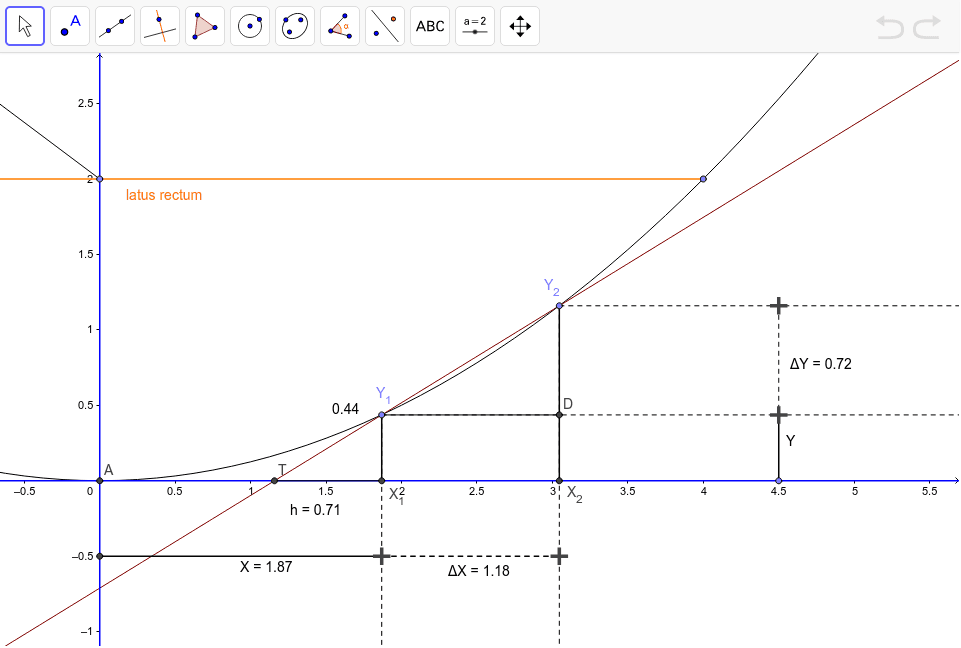
This example demonstrates the transition from a secant to a tangent on a parabola by moving sliders Y_1 and Y_2. Key mathematical concepts include the properties of parabolas and derivatives. GeoGebra commands used include Line, Point, Parabola, Intersect, Segment, OrthogonalLine, and Ray. Suitable for high school mathematics, particularly calculus and coordinate geometry courses.
GeoGebra Commands & Parameters
Line(A_1, B) → aPoint(yAxis) → CParabola(C, a) → cPoint(c) → Y_1Point(c) → Y_2Intersect(c, xAxis, 1) → ALine(A, a) → bLine(Y_1, Y_2) → dLine(Y_1, yAxis) → eLine(Y_2, yAxis) → fIntersect(b, e) → X_1Segment(Y_1, X_1) → gIntersect(b, f) → X_2Segment(Y_2, X_2) → h_2OrthogonalLine(Y_1, g) → iIntersect(i, h_2) → DSegment(Y_1, D) → jRay(Y_1, D) → kLine(Y_2, b) → lPoint(l) → JRay(Y_2, J) → mLine(K, h_2) → nIntersect(n, m) → LIntersect(n, k) → MSegment(L, M) → ΔYPoint(b) → NSegment(M, N) → YLine(Y_1, yAxis) → rLine(D, yAxis) → sLine(O, b) → tIntersect(r, t) → PIntersect(s, t) → QSegment(P, Q) → ΔXIntersect(t, yAxis) → RSegment(R, P) → XOrthogonalLine(P, X) → pPoint(p) → SPoint(p) → T_1Ray(Y_1, D) → qRay(Y_2, L) → a_1Ray(Y_1, X_1) → b_1Ray(Y_2, D) → c_1Point(c) → EPoint(c) → FSegment(E, F) → d_1OrthogonalLine(A, b) → e_1Point(c) → GSegment(C, G) → f_1OrthogonalLine(G, a) → g_1Intersect(a, g_1) → HSegment(G, H) → h_1Intersect(b, d) → TSegment(T, X_1) → h