
Law of Cosines Demonstration by David Cowan
Loading the math board and drawing, please wait…
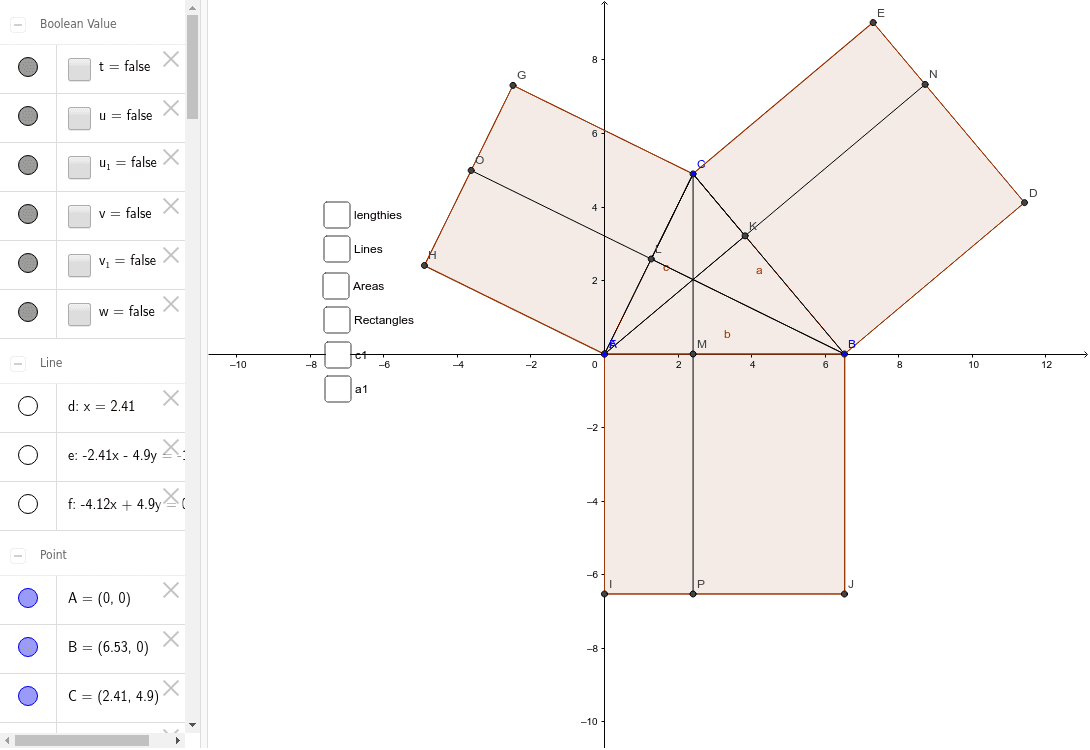
This example demonstrates the Law of Cosines in triangle geometry, illustrating the relationship between side lengths and angles dynamically. Key math concepts include the Law of Cosines, triangle properties, and linear equations. Construction involves commands/objects like Point, Polygon, OrthogonalLine, Intersect, PointIn, Segment. Suitable for high school mathematics teaching, aiding students in visualizing the proof and application of the Law of Cosines.
GeoGebra Commands & Parameters
Point(xAxis) → BPolygon(B, A, C) → poly1, b, c, aOrthogonalLine(C, b) → dOrthogonalLine(B, c) → eOrthogonalLine(A, a) → fPolygon(C, B, 4) → poly2, g, h, i, j, D, EPolygon(F, C, 4) → poly3, k, l, m, n, G, HPolygon(B, F, 4) → poly4, p, q, r, s, I, JIntersect(f, a) → KIntersect(e, c) → LIntersect(d, b) → MIntersect(f, i) → NIntersect(e, m) → OIntersect(d, r) → PPolygon(K, N, E, C) → poly5, k_1, n_1, e_1, b_1Polygon(C, L, O, G) → poly6, b_2, l_1, o, g_1PointIn(poly5) → Pointpoly5PointIn(poly6) → Pointpoly6Polygon(N, D, B, K) → poly7, n_2, d_1, c_1, k_2Polygon(B, J, P, M) → poly8, c_2, j_1, p_1, m_1PointIn(poly7) → Pointpoly7PointIn(poly8) → Pointpoly8Polygon(F, M, P, I) → poly9, f_1, m_2, p_2, i_1Polygon(F, L, O, H) → poly10, f_2, l_2, o_1, h_1PointIn(poly10) → Pointpoly10PointIn(poly9) → Pointpoly9Segment(L, B) → s_1Segment(F, K) → t_1Segment(M, C) → a_2Segment(L, O) → a_1Segment(K, N) → q_1Segment(M, P) → r_1Polygon(C, L, B) → poly11, b_3, c_3, l_3Polygon(C, K, F) → poly12, f_3, c_4, k_3Polygon(L, B, F) → poly13, f_4, l_4, b_4
AI Drawing Prompt Reference
Draw a triangle ABC with points A, B, and C on the x-axis. Construct perpendicular lines from point C to AB, from point B to AC, and from point A to BC. Form a quadrilateral by connecting the vertices of the triangle with their respective feet of the perpendiculars, creating several intersection points and segments. Use these points and segments to construct multiple triangles and quadrilaterals, illustrating the relationship between side lengths and angles in a triangle, as well as the properties of the triangle.
The prompt above was compiled from the original drawing commands and is for reference only.