
Law of Cosines by Leslee Villalobos
Loading the math board and drawing, please wait…
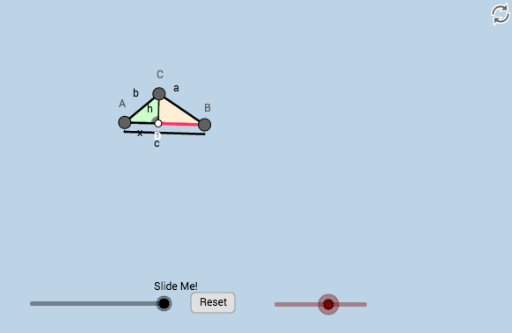
This example demonstrates the Law of Cosines, which states that in any triangle, the square of one side is equal to the sum of the squares of the other two sides minus twice their product with the cosine of the included angle. Using GeoGebra commands such as Rotate, Angle, Ray, and Segment, the example dynamically illustrates the application of the Law of Cosines. Suitable for middle school and above students to learn trigonometry and geometric construction.
GeoGebra Commands & Parameters
Rotate(A_1, α, C) → A'Angle(A_1, C, A') → βRay(A_1, A') → fSegment(A_1, C) → gRay(C, A') → hRay(C, A_1) → iPoint(i) → APoint(h) → BSegment(A, B) → jSegment(C, A) → kSegment(C, B) → lOrthogonalLine(C, j) → mIntersect(m, j) → DPolygon(A, D, C) → poly1, b, c, ePolygon(D, C, B) → poly2, d, e_1, b_1Angle(C, D, A) → γDistance(A, D) → aDistance(D, B) → nMin(a, n) → oCircle(D, (0.2 * o)) → pSegment(C, D) → qIntersect(p, j) → F, GIntersect(p, q) → H,CircleSector(D, G, H) → rDilate(C, If[0 < s ≤ 1, 1 - s, 0], D) → B'Segment(C, B') → tRotate(r, If[1.5 < s ≤ 2.5, ((s - 1.5) * π / 2), π / 2], D) → r'Dilate(D, If[2.5 < s ≤ 3.5, 3.5 - s, 0], A) → E'Dilate(C, If[2.5 < s ≤ 3.5, 3.5 - s, 0], A) → B'_1Segment(C, B'_1) → f_1Segment(D, E') → g_1Circle(D, 1) → c_1Intersect(c_1, m, 1) → ILine(A, m) → h_1Line(B, m) → i_1OrthogonalLine(I, m) → j_1Intersect(h_1, j_1) → JIntersect(i_1, j_1) → KPolygon(A, D, C) → poly3, c_2, a_1, d_1Dilate(D, If[2.5 < s ≤ 3.5, 3.5 - s, 0], B) → D'Dilate(C, If[2.5 < s ≤ 3.5, 3.5 - s, 0], B) → C'Segment(C, C') → k_1Segment(D, D') → l_1Dilate(A, If[3.5 < s ≤ 4.5, 4.5 - s, 0], J) → A'_1Dilate(B, If[3.5 < s ≤ 4.5, 4.5 - s, 0], K) → B'_2Segment(A, A'_1) → m_1Segment(B, B'_2) → n_1Dilate(J, If[4.5 < s ≤ 5.5, 5.5 - s, 0], K) → J'Segment(J, J') → p_1