
Lattice Polygons
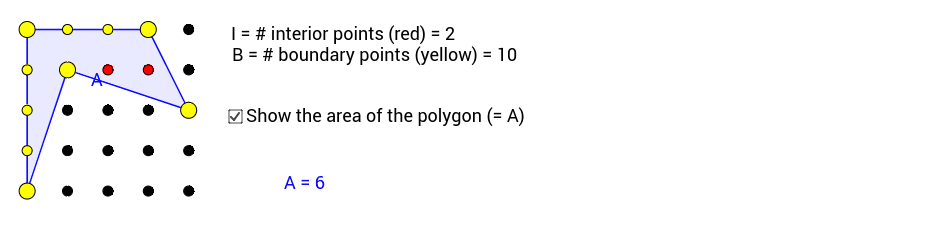
Loading the math board and drawing, please wait…
This example explores the relationship between the area of a lattice polygon and the number of interior points, helping students understand polygon area calculation methods. Key mathematical concepts include polygon area, point counting, and geometric construction. It uses commands like Polygon, If, CountIf, Point, and Intersect in GeoGebra. Suitable for middle school and above students to learn polygon area calculation and geometric construction.
GeoGebra Commands & Parameters
Polygon(P_1, P_2, P_3, P_4, P_5) → poly1, b_1, c_1, d_1, e_1, a_1If(IsInRegion[B, poly1], 1, 0) → b1If(IsInRegion[C, poly1], 1, 0) → c1If(IsInRegion[D, poly1], 1, 0) → d1If(IsInRegion[E, poly1], 1, 0) → e1If(IsInRegion[F, poly1], 1, 0) → f1If(IsInRegion[G, poly1], 1, 0) → g1If(IsInRegion[H, poly1], 1, 0) → h1If(IsInRegion[I, poly1], 1, 0) → i1If(IsInRegion[J, poly1], 1, 0) → j1If(IsInRegion[K, poly1], 1, 0) → k1If(IsInRegion[L, poly1], 1, 0) → l1If(IsInRegion[M, poly1], 1, 0) → m1If(IsInRegion[N, poly1], 1, 0) → n1If(IsInRegion[O, poly1], 1, 0) → o1If(IsInRegion[P, poly1], 1, 0) → p1If(IsInRegion[Q, poly1], 1, 0) → q1If(IsInRegion[R, poly1], 1, 0) → r1If(IsInRegion[S, poly1], 1, 0) → s1If(IsInRegion[T, poly1], 1, 0) → t1If(IsInRegion[U, poly1], 1, 0) → u1If(IsInRegion[V, poly1], 1, 0) → v1If(IsInRegion[W, poly1], 1, 0) → w1If(IsInRegion[Z, poly1], 1, 0) → z1If(IsInRegion[A, poly1], 1, 0) → a1If(IsInRegion[AA, poly1], 1, 0) → aa1If(Distance[A, a_1] ≟ 0, 1, If[Distance[A, b_1] ≟ 0, 1, If[Distance[A, c_1] ≟ 0, 1, If[Distance[A, d_1] ≟ 0, 1, If[Distance[A, e_1] ≟ 0, 1, 0]]]]) → a2If(Distance[B, a_1] ≟ 0, 1, If[Distance[B, b_1] ≟ 0, 1, If[Distance[B, c_1] ≟ 0, 1, If[Distance[B, d_1] ≟ 0, 1, If[Distance[B, e_1] ≟ 0, 1, 0]]]]) → b2If(Distance[C, a_1] ≟ 0, 1, If[Distance[C, b_1] ≟ 0, 1, If[Distance[C, c_1] ≟ 0, 1, If[Distance[C, d_1] ≟ 0, 1, If[Distance[C, e_1] ≟ 0, 1, 0]]]]) → c2If(Distance[D, a_1] ≟ 0, 1, If[Distance[D, b_1] ≟ 0, 1, If[Distance[D, c_1] ≟ 0, 1, If[Distance[D, d_1] ≟ 0, 1, If[Distance[D, e_1] ≟ 0, 1, 0]]]]) → d2If(Distance[E, a_1] ≟ 0, 1, If[Distance[E, b_1] ≟ 0, 1, If[Distance[E, c_1] ≟ 0, 1, If[Distance[E, d_1] ≟ 0, 1, If[Distance[E, e_1] ≟ 0, 1, 0]]]]) → e2If(Distance[F, a_1] ≟ 0, 1, If[Distance[F, b_1] ≟ 0, 1, If[Distance[F, c_1] ≟ 0, 1, If[Distance[F, d_1] ≟ 0, 1, If[Distance[F, e_1] ≟ 0, 1, 0]]]]) → f2If(Distance[G, a_1] ≟ 0, 1, If[Distance[G, b_1] ≟ 0, 1, If[Distance[G, c_1] ≟ 0, 1, If[Distance[G, d_1] ≟ 0, 1, If[Distance[G, e_1] ≟ 0, 1, 0]]]]) → g2If(Distance[H, a_1] ≟ 0, 1, If[Distance[H, b_1] ≟ 0, 1, If[Distance[H, c_1] ≟ 0, 1, If[Distance[H, d_1] ≟ 0, 1, If[Distance[H, e_1] ≟ 0, 1, 0]]]]) → h2If(Distance[I, a_1] ≟ 0, 1, If[Distance[I, b_1] ≟ 0, 1, If[Distance[I, c_1] ≟ 0, 1, If[Distance[I, d_1] ≟ 0, 1, If[Distance[I, e_1] ≟ 0, 1, 0]]]]) → i2If(Distance[J, a_1] ≟ 0, 1, If[Distance[J, b_1] ≟ 0, 1, If[Distance[J, c_1] ≟ 0, 1, If[Distance[J, d_1] ≟ 0, 1, If[Distance[J, e_1] ≟ 0, 1, 0]]]]) → j2If(Distance[K, a_1] ≟ 0, 1, If[Distance[K, b_1] ≟ 0, 1, If[Distance[K, c_1] ≟ 0, 1, If[Distance[K, d_1] ≟ 0, 1, If[Distance[K, e_1] ≟ 0, 1, 0]]]]) → k2If(Distance[L, a_1] ≟ 0, 1, If[Distance[L, b_1] ≟ 0, 1, If[Distance[L, c_1] ≟ 0, 1, If[Distance[L, d_1] ≟ 0, 1, If[Distance[L, e_1] ≟ 0, 1, 0]]]]) → l2If(Distance[M, a_1] ≟ 0, 1, If[Distance[M, b_1] ≟ 0, 1, If[Distance[M, c_1] ≟ 0, 1, If[Distance[M, d_1] ≟ 0, 1, If[Distance[M, e_1] ≟ 0, 1, 0]]]]) → m2If(Distance[N, a_1] ≟ 0, 1, If[Distance[N, b_1] ≟ 0, 1, If[Distance[N, c_1] ≟ 0, 1, If[Distance[N, d_1] ≟ 0, 1, If[Distance[N, e_1] ≟ 0, 1, 0]]]]) → n2If(Distance[O, a_1] ≟ 0, 1, If[Distance[O, b_1] ≟ 0, 1, If[Distance[O, c_1] ≟ 0, 1, If[Distance[O, d_1] ≟ 0, 1, If[Distance[O, e_1] ≟ 0, 1, 0]]]]) → o2If(Distance[P, a_1] ≟ 0, 1, If[Distance[P, b_1] ≟ 0, 1, If[Distance[P, c_1] ≟ 0, 1, If[Distance[P, d_1] ≟ 0, 1, If[Distance[P, e_1] ≟ 0, 1, 0]]]]) → p2If(Distance[Q, a_1] ≟ 0, 1, If[Distance[Q, b_1] ≟ 0, 1, If[Distance[Q, c_1] ≟ 0, 1, If[Distance[Q, d_1] ≟ 0, 1, If[Distance[Q, e_1] ≟ 0, 1, 0]]]]) → q2If(Distance[R, a_1] ≟ 0, 1, If[Distance[R, b_1] ≟ 0, 1, If[Distance[R, c_1] ≟ 0, 1, If[Distance[R, d_1] ≟ 0, 1, If[Distance[R, e_1] ≟ 0, 1, 0]]]]) → r2If(Distance[S, a_1] ≟ 0, 1, If[Distance[S, b_1] ≟ 0, 1, If[Distance[S, c_1] ≟ 0, 1, If[Distance[S, d_1] ≟ 0, 1, If[Distance[S, e_1] ≟ 0, 1, 0]]]]) → s2If(Distance[T, a_1] ≟ 0, 1, If[Distance[T, b_1] ≟ 0, 1, If[Distance[T, c_1] ≟ 0, 1, If[Distance[T, d_1] ≟ 0, 1, If[Distance[T, e_1] ≟ 0, 1, 0]]]]) → t2If(Distance[U, a_1] ≟ 0, 1, If[Distance[U, b_1] ≟ 0, 1, If[Distance[U, c_1] ≟ 0, 1, If[Distance[U, d_1] ≟ 0, 1, If[Distance[U, e_1] ≟ 0, 1, 0]]]]) → u2If(Distance[V, a_1] ≟ 0, 1, If[Distance[V, b_1] ≟ 0, 1, If[Distance[V, c_1] ≟ 0, 1, If[Distance[V, d_1] ≟ 0, 1, If[Distance[V, e_1] ≟ 0, 1, 0]]]]) → v2If(Distance[W, a_1] ≟ 0, 1, If[Distance[W, b_1] ≟ 0, 1, If[Distance[W, c_1] ≟ 0, 1, If[Distance[W, d_1] ≟ 0, 1, If[Distance[W, e_1] ≟ 0, 1, 0]]]]) → w2If(Distance[Z, a_1] ≟ 0, 1, If[Distance[Z, b_1] ≟ 0, 1, If[Distance[Z, c_1] ≟ 0, 1, If[Distance[Z, d_1] ≟ 0, 1, If[Distance[Z, e_1] ≟ 0, 1, 0]]]]) → z2If(Distance[AA, a_1] ≟ 0, 1, If[Distance[AA, b_1] ≟ 0, 1, If[Distance[AA, c_1] ≟ 0, 1, If[Distance[AA, d_1] ≟ 0, 1, If[Distance[AA, e_1] ≟ 0, 1, 0]]]]) → aa2CountIf(x < 1, {x(P_1), x(P_2), x(P_3), x(P_4), x(P_5), y(P_1), y(P_2), y(P_3), y(P_4), y(P_5)}) → zahl1CountIf(x > 5, {x(P_1), x(P_2), x(P_3), x(P_4), x(P_5), y(P_1), y(P_2), y(P_3), y(P_4), y(P_5)}) → zahl2If(summe ≟ 0, true, false) → gueltigIf(gueltig ≟ true, false, true) → ungueltigIf(gueltig ≟ true, If[a ≟ true, true, false], false) → gueltig1Point(Circle[E_1, 1]) → F_1Intersect(a_1, c_1) → S_1Intersect(a_1, d_1) → S_2Intersect(b_1, d_1) → S_3Intersect(b_1, e_1) → S_4Intersect(c_1, e_1) → S_5If(Defined[S_1], true, If[Defined[S_2], true, If[Defined[S_3], true, If[Defined[S_4], true, If[Defined[S_5], true, false]]]]) → notsimple
AI Drawing Prompt Reference
Draw a pentagon and then draw several points inside it. Mark these points and check if they are inside the pentagon. Then, calculate the distance from each point to the vertices of the pentagon to determine if each point coincides with a vertex.
The prompt above was compiled from the original drawing commands and is for reference only.