
Kite Tessellation
Loading the math board and drawing, please wait…
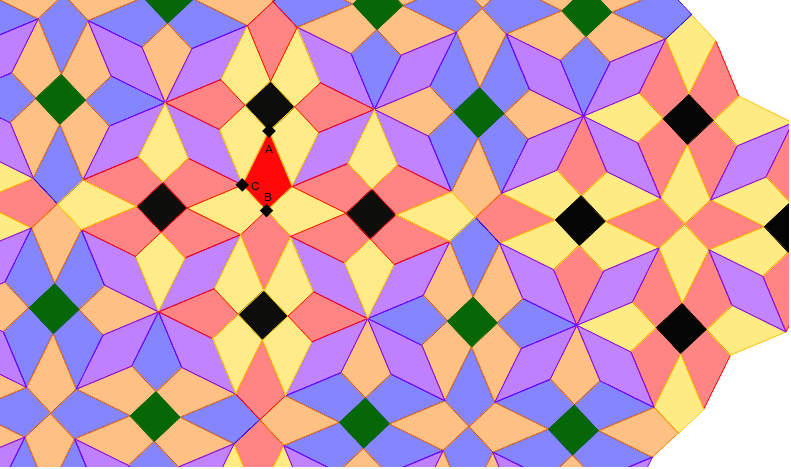
This GeoGebra example demonstrates a plane tessellation composed of kite-shaped quadrilaterals, created by applying rotations, reflections, and translations to fill the plane seamlessly. The core mathematical concepts include tessellation, geometric transformations (rotation, reflection, translation), and polygon symmetry. The construction uses GeoGebra commands such as Point, Mirror, Polygon, Rotate, Midpoint, and Sequence, as seen in the summary: a base kite polygon (poly1) is defined and then replicated via rotations and reflections to generate a periodic pattern. This is suitable for middle or high school geometry classes, art-mathematics integration, or tessellation workshops, helping students explore symmetry, transformations, and the mathematics of tiling.
GeoGebra Commands & Parameters
Point(Ray[B, Rotate[A, 45°, B]]) → CMirror(C, Line[A, B]) → C'Polygon(B, C, A, C') → poly1, b, c, a, c'Rotate(B, 90°, B) → B'Rotate(C, 90°, B) → C'_1Rotate(A, 90°, B) → A'Rotate(C', 90°, B) → C''Polygon(B', C'_1, A', C'') → poly1', b', c'_1, a', c''Rotate(B', 90°, B) → B''Rotate(C'_1, 90°, B) → DRotate(A', 90°, B) → A''Rotate(C'', 90°, B) → C'''Polygon(B'', D, A'', C''') → poly1'', b'', d, a'', c'''Rotate(B'', 90°, B) → B'''Rotate(D, 90°, B) → D'Rotate(A'', 90°, B) → A'''Rotate(C''', 90°, B) → EPolygon(B''', D', A''', E) → poly1''', b''', d', a''', eMidpoint(c) → FMidpoint(a) → GRotate(B, 180°, F) → B'_1Rotate(C, 180°, F) → C'_2Rotate(A, 180°, F) → A'_1Rotate(C', 180°, F) → C''_1Polygon(B'_1, C'_2, A'_1, C''_1) → poly1'_1, b'_1, c'_2, a'_1, c''_1Rotate(B, 180°, G) → B'_2Rotate(C, 180°, G) → C'_3Rotate(A, 180°, G) → A'_2Rotate(C', 180°, G) → C''_2Polygon(B'_2, C'_3, A'_2, C''_2) → poly1'_2, b'_2, c'_3, a'_2, c''_2Rotate(B'_1, 90°, B) → HRotate(C'_2, 90°, B) → IRotate(A'_1, 90°, B) → JRotate(C''_1, 90°, B) → KPolygon(H, I, J, K) → poly2, h, i, j, kRotate(B'_2, 90°, B) → LRotate(C'_3, 90°, B) → MRotate(A'_2, 90°, B) → NRotate(C''_2, 90°, B) → OPolygon(L, M, N, O) → poly3, l, m, n, oRotate(H, 90°, B) → H'Rotate(I, 90°, B) → I'Rotate(J, 90°, B) → J'Rotate(K, 90°, B) → K'Polygon(H', I', J', K') → poly2', h', i', j', k'Rotate(L, 90°, B) → L'Rotate(M, 90°, B) → M'Rotate(N, 90°, B) → N'Rotate(O, 90°, B) → O'Polygon(L', M', N', O') → poly3', l', m', n', o'Rotate(H', 90°, B) → H''Rotate(I', 90°, B) → I''Rotate(J', 90°, B) → J''Rotate(K', 90°, B) → K''Polygon(H'', I'', J'', K'') → poly2'', h'', i'', j'', k''Rotate(L', 90°, B) → L''Rotate(M', 90°, B) → M''Rotate(N', 90°, B) → N''Rotate(O', 90°, B) → O''Polygon(L'', M'', N'', O'') → poly3'', l'', m'', n'', o''Midpoint(B'_1, B'_2) → PRotate(B'_2, 180°, P) → QRotate(C'_3, 180°, P) → RRotate(A'_2, 180°, P) → SRotate(C''_2, 180°, P) → TPolygon(Q, R, S, T) → poly4, q, r, s, tRotate(B'_1, 180°, P) → URotate(C'_2, 180°, P) → VRotate(A'_1, 180°, P) → WRotate(C''_1, 180°, P) → ZPolygon(U, V, W, Z) → poly5, u, v, w, z_1Rotate(Q, 90°, B'_1) → Q'Rotate(R, 90°, B'_1) → R'Rotate(S, 90°, B'_1) → S'Rotate(T, 90°, B'_1) → T'Polygon(Q', R', S', T') → poly4', q', r', s', t'Rotate(B'_2, 90°, B'_2) → A_1Rotate(C'_3, 90°, B'_2) → B_1Rotate(A'_2, 90°, B'_2) → C_1Rotate(C''_2, 90°, B'_2) → D_1Polygon(A_1, B_1, C_1, D_1) → poly6, a_1, b_1, c_1, d_1Rotate(Q', 90°, B) → Q''Rotate(R', 90°, B) → R''Rotate(S', 90°, B) → S''Rotate(T', 90°, B) → T''Polygon(Q'', R'', S'', T'') → poly4'', q'', r'', s'', t''Rotate(Q, 90°, B) → Q'_1Rotate(R, 90°, B) → R'_1Rotate(S, 90°, B) → S'_1Rotate(T, 90°, B) → T'_1Polygon(Q'_1, R'_1, S'_1, T'_1) → poly4'_1, q'_1, r'_1, s'_1, t'_1Rotate(U, 90°, B) → U'Rotate(V, 90°, B) → V'Rotate(W, 90°, B) → W'Rotate(Z, 90°, B) → Z'Polygon(U', V', W', Z') → poly5', u', v', w', z'Rotate(A_1, 90°, B) → E_1Rotate(B_1, 90°, B) → F_1Rotate(C_1, 90°, B) → G_1Rotate(D_1, 90°, B) → H_1Polygon(E_1, F_1, G_1, H_1) → poly6', e_1, f_1, g_1, h_1Rotate(B, 180°, P) → B'_3Rotate(C, 180°, P) → C'_4Rotate(A, 180°, P) → A'_3Rotate(C', 180°, P) → C''_3Polygon(B'_3, C'_4, A'_3, C''_3) → poly1'_3, b'_3, c'_4, a'_3, c''_3Rotate(B'_3, 90°, B) → I_1Rotate(C'_4, 90°, B) → J_1Rotate(A'_3, 90°, B) → K_1Rotate(C''_3, 90°, B) → L_1Polygon(I_1, J_1, K_1, L_1) → poly7, i_1, j_1, k_1, l_1Rotate(I_1, 90°, B) → M_1Rotate(J_1, 90°, B) → N_1Rotate(K_1, 90°, B) → O_1Rotate(L_1, 90°, B) → P_1Polygon(M_1, N_1, O_1, P_1) → poly7', m_1, n_1, o_1, p_1Rotate(I_1, 90°, B) → Q_1Rotate(J_1, 90°, B) → R_1Rotate(K_1, 90°, B) → S_1Rotate(L_1, 90°, B) → T_1Rotate(I_1, 90°, B) → U_1Rotate(J_1, 90°, B) → V_1Rotate(K_1, 90°, B) → W_1Rotate(L_1, 90°, B) → Z_1Rotate(E_1, 90°, B) → A_2Rotate(F_1, 90°, B) → B_2Rotate(G_1, 90°, B) → C_2Rotate(H_1, 90°, B) → D_2Polygon(A_2, B_2, C_2, D_2) → poly6'', a_2, b_2, c_2, d_2Rotate(U', 90°, B) → U''Rotate(V', 90°, B) → V''Rotate(W', 90°, B) → W''Rotate(Z', 90°, B) → Z''Polygon(U'', V'', W'', Z'') → poly5'', u'', v'', w'', z''Rotate(Q'_1, 90°, B) → E_2Rotate(R'_1, 90°, B) → F_2Rotate(S'_1, 90°, B) → G_2Rotate(T'_1, 90°, B) → H_2Polygon(E_2, F_2, G_2, H_2) → poly8, e_2, f_2, g_2, h_2Rotate(Q'', 90°, B) → Q'''Rotate(R'', 90°, B) → R'''Rotate(S'', 90°, B) → S'''Rotate(T'', 90°, B) → T'''Polygon(Q''', R''', S''', T''') → poly4''', q''', r''', s''', t'''Rotate(A_2, 90°, B) → I_2Rotate(B_2, 90°, B) → J_2Rotate(C_2, 90°, B) → K_2Rotate(D_2, 90°, B) → L_2Polygon(I_2, J_2, K_2, L_2) → poly6''', i_2, j_2, k_2, l_2Rotate(U'', 90°, B) → U'''Rotate(V'', 90°, B) → V'''Rotate(W'', 90°, B) → W'''Rotate(Z'', 90°, B) → Z'''Polygon(U''', V''', W''', Z''') → poly5''', u''', v''', w''', z'''Rotate(E_2, 90°, B) → M_2Rotate(F_2, 90°, B) → N_2Rotate(G_2, 90°, B) → O_2Rotate(H_2, 90°, B) → P_2Polygon(M_2, N_2, O_2, P_2) → poly8', m_2, n_2, o_2, p_2Rotate(M_1, 90°, B) → Q_2Rotate(N_1, 90°, B) → R_2Rotate(O_1, 90°, B) → S_2Rotate(P_1, 90°, B) → T_2Polygon(Q_2, R_2, S_2, T_2) → poly7'', q_2, r_2, s_2, t_2Rotate(Q''', 90°, B) → U_2Rotate(R''', 90°, B) → V_2Rotate(S''', 90°, B) → W_2Rotate(T''', 90°, B) → Z_2Polygon(U_2, V_2, W_2, Z_2) → poly9, u_2, v_2, w_2, z_2Sequence(Rotate[Polygon[Sequence[Rotate[A, ((i * 90))°, P], i, 1, 4]], ((j * 90))°, B], j, 1, 4) → list1Sequence(Polygon[Rotate[C, ((j * 90))°, B], Rotate[M, ((j * 90))°, B], Rotate[S', ((j * 90))°, B], Rotate[R', ((j * 90))°, B]], j, 1, 4) → list2Sequence(Rotate[Rotate[listR, 180°, B'_3], ((i * 90))°, B], i, 1, 4) → list3Sequence(Rotate[Rotate[listY, 180°, B'_3], ((i * 90))°, B], i, 1, 4) → list4Sequence(Rotate[Rotate[list1, 180°, B'_3], ((i * 90))°, B], i, 1, 4) → list5Sequence(Rotate[Rotate[list2, 180°, B'_3], ((i * 90))°, B], i, 1, 4) → list6Sequence(Rotate[Rotate[listR, 180°, S'], ((i * 90))°, B], i, 1, 4) → list7Sequence(Rotate[Rotate[listY, 180°, S'], ((i * 90))°, B], i, 1, 4) → list8Sequence(Rotate[Rotate[list1, 180°, S'], ((i * 90))°, B], i, 1, 4) → list9Sequence(Rotate[Rotate[list2, 180°, S'], ((i * 90))°, B], i, 1, 4) → list10Sequence(Rotate[Sequence[Polygon[Rotate[C, ((i * 180))° + 90°, S'], Rotate[M, ((i * 180))° + 90°, S'], Rotate[S', ((i * 180))° + 90°, S'], Rotate[R', ((i * 180))° + 90°, S']], i, 1, 2], ((j * 90))°, B], j, 1, 4) → list11Sequence(Rotate[Rotate[list11, 180°, S'], ((i * 90))°, B], i, 1, 4) → list12
AI Drawing Prompt Reference
Draw a plane tessellation made of kite-shaped quadrilaterals. Start with a single symmetric kite defined by a base segment, a point rotated 45 degrees from one endpoint, and its mirror image across the base line. Then rotate this kite by 90, 180, and 270 degrees around one endpoint of the base, creating four kites around that center. Next, reflect the original kite by 180 degrees about the midpoints of its two opposite sides, producing two flipped kites. Finally, rotate these flipped kites by 90, 180, and 270 degrees around the same center point, filling the plane with a seamless periodic pattern of interlocking kites.
The prompt above was compiled from the original drawing commands and is for reference only.