
Kite-Shaped Solid: Rotation and Surface Construction
Loading the math board and drawing, please wait…
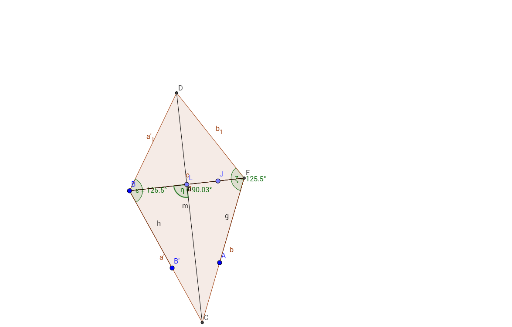
① This example illustrates how to generate a kite-shaped solid and its surface in 3D space through rotation, intersection, and polygon construction. ② Core mathematical concepts include rotational solids, plane-solid intersections, polygonal faces, segments, angles, and statistical characteristics like surface area or volume. ③ Construction highlights: from the summary, GeoGebra commands such as Rotate, Angle, Segment, Line, Intersect, Polygon, and Point are used, creating many objects (A, B, A', α, f, B', β, g, h, i, j, C, poly1, b, c, a', A'', γ, B'_1, δ, k, l, D, poly2, a'_1, d, b_1, m, ε, E, ζ, F, G, n, H, I, J, K, L, η) to define rotated points, lines, faces, and intersection curves. ④ Suitable for high school or early college solid geometry and geometric construction lessons, and for exploring rotational symmetry and surface construction.
GeoGebra Commands & Parameters
Rotate(A, 45°, B) → A'Angle(A, B, A') → αSegment(B, A') → fRotate(B, 45°, A') → B'Angle(B, A', B') → βSegment(A', A) → gSegment(B', B) → hLine(A', A) → iLine(B, B') → jIntersect(i, j) → CPolygon(C, A', B) → poly1, b, c, a'Rotate(A', 64°, B) → A''Angle(A', B, A'') → γRotate(B, (-(64°)), A') → B'_1Angle(B'_1, A', B) → δLine(A', A'') → kLine(B, B'_1) → lIntersect(k, l) → DPolygon(D, B, A') → poly2, a'_1, d, b_1Segment(D, C) → mAngle(C, B, D) → εIntersect(k, f) → EAngle(D, E, C) → ζIntersect(f, c) → FIntersect(f, c) → GSegment(B, E) → nIntersect(f, c) → HIntersect(f, c) → IPoint(f) → JIntersect(f, c) → KPoint(poly2) → LAngle(B, L, C) → η