
Kite Construction and Geometry
Loading the math board and drawing, please wait…
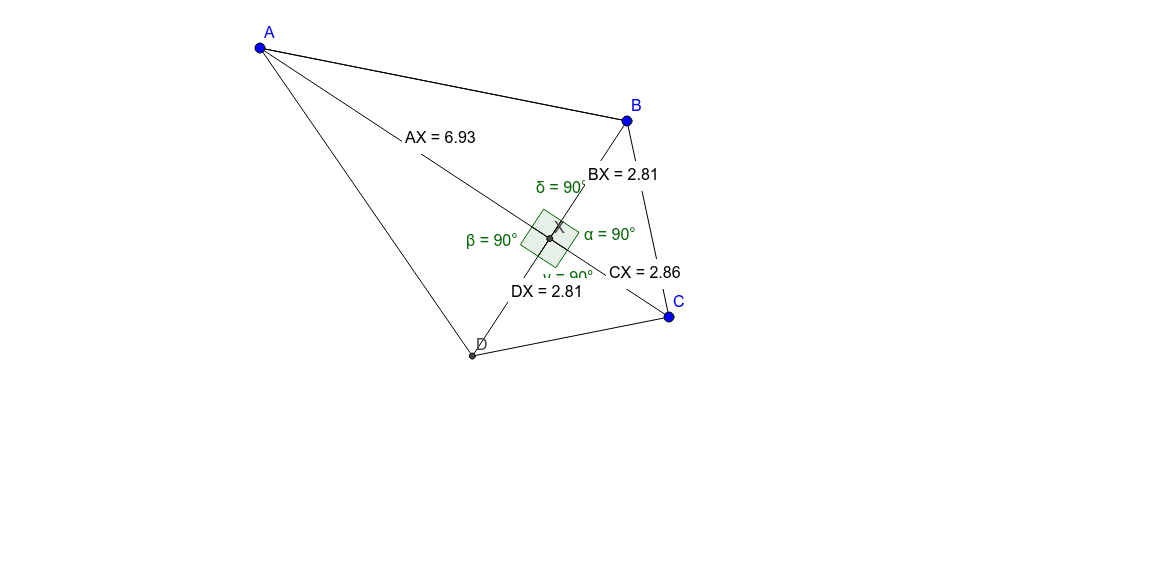
This example demonstrates the geometric construction of a kite and its related properties, involving core math concepts like frequency distribution, arithmetic mean, triangles, surface area, and volume. It uses GeoGebra commands such as Segment, Circle, Intersect, Angle, Distance, and Midpoint for construction. Suitable for high school and above learners to understand geometric constructions and spatial geometry relationships.
GeoGebra Commands & Parameters
Segment(A, B) → aSegment(A, B) → bSegment(B, C) → cCircle(A, B) → dCircle(C, B) → eIntersect(d, e, 2) → DSegment(A, D) → fSegment(D, C) → gSegment(D, B) → hSegment(A, C) → iIntersect(h, i) → XAngle(i, h) → αAngle(A, X, D) → βAngle(D, X, C) → γAngle(B, X, A) → δDistance(B, X) → distanceBXMidpoint(B, X) →Distance(C, X) → distanceCXMidpoint(C, X) →Distance(D, X) → distanceDXMidpoint(D, X) →Distance(A, X) → distanceAXMidpoint(A, X) →
AI Drawing Prompt Reference
Draw a geometric construction of a kite, highlighting its key points and relationships. Start by drawing two equal line segments to form one pair of diagonals of the kite. Then, draw two circles with these segments as radii centered at their intersection point, and find the intersections of these circles. Connect these points to form the four vertices of the kite. Next, calculate and label the angles at the intersection of the diagonals, as well as the midpoints of each side. Finally, measure and label the lengths of the key line segments to reveal the kite's geometric properties.
The prompt above was compiled from the original drawing commands and is for reference only.