
Kaylie Number Stack: Polygon Midpoint Stacking Construction
Loading the math board and drawing, please wait…
In collections
Pyramid Puzzles
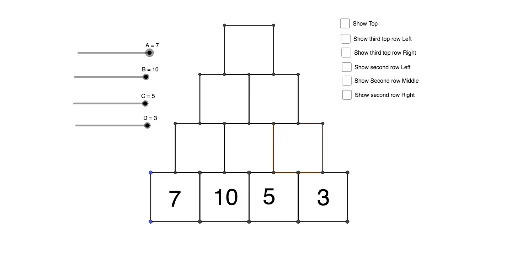
① This example demonstrates a geometric figure called 'Kaylie Number Stack', formed by stacking multiple polygons connected through midpoints, showing an iterative midpoint-based construction. ② Core mathematical concepts include polygons, midpoints, and iterative generation of new polygons by connecting midpoints, involving geometric transformations and sequence ideas. ③ Construction highlights: From the construction summary, GeoGebra commands Polygon and Midpoint are used to create multiple polygons (poly1 to poly5) and generate midpoints of sides (e.g., A_2, B_2, C_2, etc.), then new polygons are formed by connecting these midpoints, creating a stacked structure; objects include points, segments, polygons, and functions f, g, etc., possibly for auxiliary calculations or display. ④ Suitable for middle/high school geometry teaching, exploring properties of midpoint polygons, iterative construction patterns, and also as an example for mathematical art or programming-based geometric design.
GeoGebra Commands & Parameters
Polygon(A_2, B_2, 4) → poly1, f, g, h, i, C_2, D_2Polygon(D_2, C_2, 4) → poly2, j, k, l, m, E, FPolygon(F, E, 4) → poly3, n, p, q, r, G, HPolygon(H, G, 4) → poly4, s, t, a_2, b_2, I_1, JMidpoint(F, H) → MMidpoint(H, J) → NMidpoint(A_2, D_2) → KMidpoint(D_2, F) → LPolygon(K, L, 4) → poly5, c, d, e, f_1, O, PPolygon(O, L, 4) → poly7, k_1, l_1, m_1, n_1, S, TPolygon(T, M, 4) → poly8, p_1, q_1, r_1, s_1, U, VMidpoint(P, O) → QMidpoint(O, T) → RMidpoint(T, V) → WPolygon(Q, R, 4) → poly6, g_1, h_1, i_1, j_1, Z, A_1Polygon(Z, R, 4) → poly9, t_1, a_1, b_1, c_1, B_1, C_1Midpoint(A_1, Z) → D_1Midpoint(Z, C_1) → E_1Polygon(D_1, E_1, 4) → poly10, d_1, e_1, f_2, g_2, F_1, G_1