
Isosceles Triangle Orthocenter: Construction and Proof
Loading the math board and drawing, please wait…
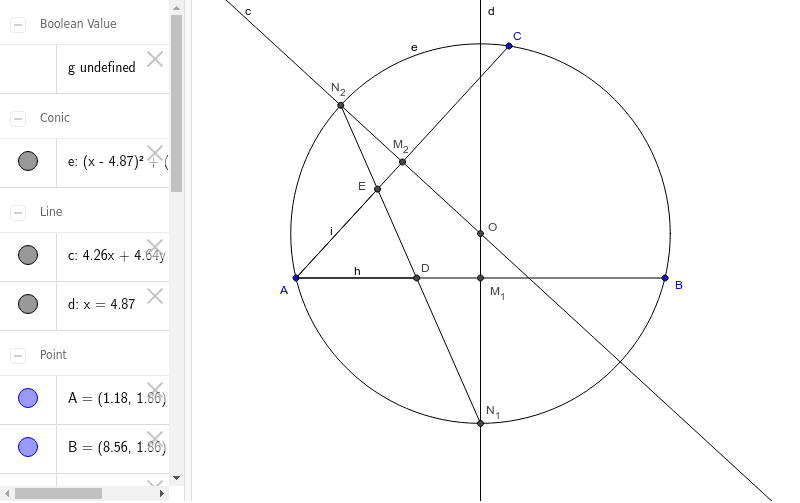
This GeoGebra example demonstrates that the three altitudes of an isosceles triangle are concurrent at the orthocenter, which lies on the triangle's axis of symmetry. Core mathematical concepts include triangle orthocenter, isosceles triangle symmetry, perpendicular lines, midpoints, circles, segment distance, segment congruence, and formal geometric proof. The construction follows the provided command summary: Segment draws the triangle sides AB, BC, and CA; Midpoint creates side midpoints M_1 and M_2; OrthogonalLine constructs the altitudes, and Intersect locates their common point O; Circle supports auxiliary constructions, Distance measures segment lengths, AreCongruent verifies segment equality, and Prove validates the geometric conclusion. Key objects include vertices A, B, C, altitude feet D, E, F, and segments AD, AE. This resource is suitable for high school geometry instruction, orthocenter theorem exploration, and GeoGebra construction practice, serving both classroom demonstrations and independent student inquiry into isosceles triangle symmetry and orthocenter properties.
GeoGebra Commands & Parameters
Segment(C, A) → aSegment(A, B) → bMidpoint(A, B) → M_1Midpoint(A, C) → M_2OrthogonalLine(M_2, a) → cOrthogonalLine(M_1, b) → dIntersect(c, d) → OCircle(O, A) → eIntersect(e, d) → N_1, E_1Intersect(e, c) → N_2, FSegment(N_2, N_1) → fIntersect(b, f) → DIntersect(a, f) → EDistance(A, D) → ADDistance(A, E) → AEAreCongruent(AD, AE) →Segment(A, D) → hSegment(A, E) → iProve(AreCongruent[i, h]) → g