
Isosceles Trapezoid: Geometric Construction and Statistical Analysis
Loading the math board and drawing, please wait…
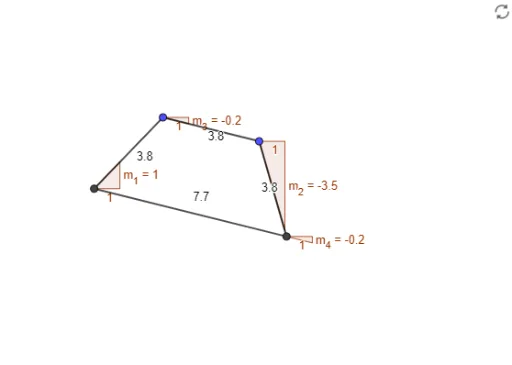
The isosceles trapezoid is a special type of trapezoid with equal non-parallel sides and equal base angles. This example demonstrates its construction using GeoGebra, involving concepts of parallel lines, slope calculation, and coordinate geometry. Key construction steps include using Polygon, Segment, and Slope commands to define vertices A, B, C, D, and calculating slopes m1, m2, m3, m4. Suitable for middle school students learning geometric construction and statistical analysis, useful in math teaching and problem-solving.
GeoGebra Commands & Parameters
Polygon(A, B, 6) → poly1, f, F, g, h, i, j, k, C, D, ESegment(F, C) → lSegment(C, B) → mSegment(B, A) → nSegment(A, F) → pSlope(m) → m_1Slope(p) → m_2Slope(n) → m_3Slope(l) → m_4
AI Drawing Prompt Reference
Draw an isosceles trapezoid to demonstrate its geometric construction, involving parallel lines, slope calculation, and coordinate geometry. Start by creating a hexagon and extract four of its sides to form the trapezoid's bases and non-parallel sides. Calculate and label the slopes of each side to illustrate the symmetry and geometric relationships of the isosceles trapezoid.
The prompt above was compiled from the original drawing commands and is for reference only.