
Isosceles Trapezoid Exploration: Diagonal Lengths and Ratios
Loading the math board and drawing, please wait…
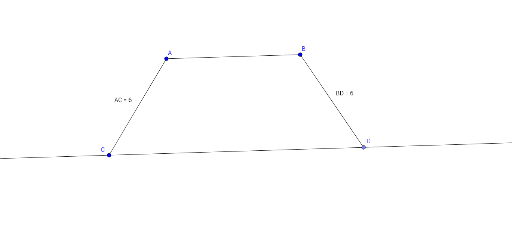
This example demonstrates the geometric properties of an isosceles trapezoid, focusing on the equality of its diagonals and related proportional relationships. Core mathematical concepts include the definition of an isosceles trapezoid (equal legs and base angles), diagonal properties, segment length measurement, and ratio calculations. Construction highlights: using GeoGebra commands such as Segment, Line, Point, and Distance to build trapezoid ABCD with AB as the lower base and CD as the upper base, then measuring diagonals AC and BD, with text objects (TextBD, TextAC) dynamically displaying their lengths. Suitable for middle school geometry classes, this exploration helps students visually verify the theorem that diagonals of an isosceles trapezoid are equal, and encourages observation of invariant properties under dynamic changes, fostering geometric intuition and reasoning skills.
GeoGebra Commands & Parameters
Segment(A, B) → fLine(C, f) → gPoint(g) → DSegment(A, C) → hSegment(B, D) → iDistance(A, C) → distanceACDistance(B, D) → distanceBDDistance(A, C) → AC
AI Drawing Prompt Reference
Draw an isosceles trapezoid with a horizontal lower base and a shorter parallel upper base. Start by placing the two endpoints of the lower base, then construct a line through one upper vertex parallel to the lower base, and pick a point on that line as the other upper vertex. Connect the four vertices to form the trapezoid. Then draw both diagonals and measure their lengths, displaying the two length values as text near the figure. The diagram should clearly show the symmetry of the isosceles trapezoid and emphasize that the diagonals are equal in length.
The prompt above was compiled from the original drawing commands and is for reference only.