
Investigating Motion: Ferris Wheel (Completed)
Loading the math board and drawing, please wait…
In collections
Precal
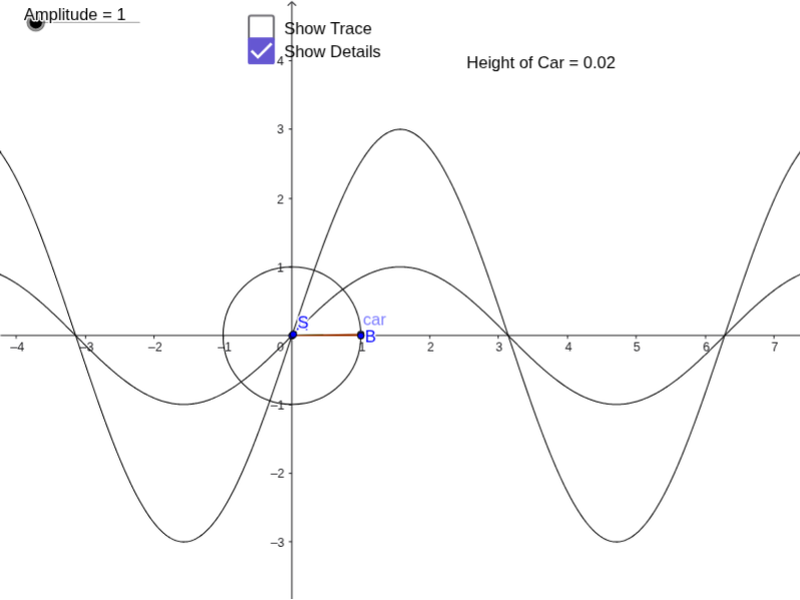
This example investigates the motion of a Ferris wheel and the height variation of its cabins over time, using a sine function to model the periodic movement. The core mathematical concepts include circles, trigonometric functions, the unit circle, linear equations, and correlation, providing insight into periodic phenomena. The construction employs GeoGebra commands such as Circle, Point, Angle, and Polygon, with objects like A, Amplitude, C, θ, and sliders to control parameters, dynamically drawing the cabin's trajectory and height graph. It is suitable for high‑school and college students to explore applications of trigonometric functions, parametric plotting, and the integration of geometry with motion.
GeoGebra Commands & Parameters
Circle(A, Amplitude) → cPoint(c) → carAngle(C, A, car) → θPolygon(car, B, A) → poly1, a_1, car_1, b_1
AI Drawing Prompt Reference
Draw a Ferris wheel using a circle with center A and radius Amplitude. Place a point car on the circle to represent a cabin on the wheel. Construct an angle θ using points C, A, and car. Use points car, B, and A to construct a quadrilateral representing the cabin's trajectory.
The prompt above was compiled from the original drawing commands and is for reference only.