
Inverse Scale Dilation
Loading the math board and drawing, please wait…
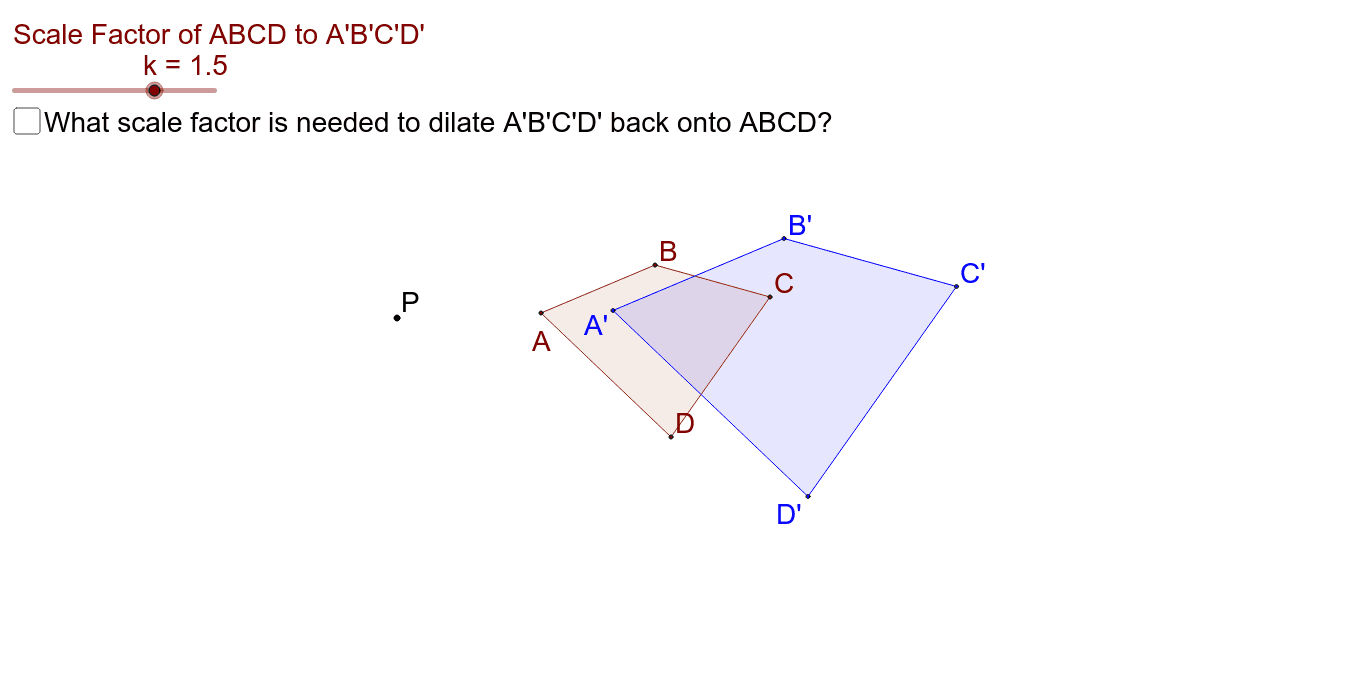
This example demonstrates the process of inverse scale dilation. Key mathematical concepts include similar triangles and proportional relationships. Using the Dilate command, the scaled image is constructed. This example involves geometric construction, transformation, and proportional relationships. Suitable for middle school and above students to learn about similar figures and scale transformations.
GeoGebra Commands & Parameters
Dilate(A, k, P) → A'Polygon(A, B, C, D) → poly1, a, b, c, dDilate(B, k, P) → B'Dilate(C, k, P) → C'Dilate(D, k, P) → D'Polygon(A', B', C', D') → poly1', a', b', c', d'Textfield(m) → inputBox1Dilate(B', f, P) → B''Dilate(C', f, P) → C''Dilate(D', f, P) → D''Dilate(A', f, P) → A''Polygon(A'', B'', C'', D'') → poly1'', a'', b'', c'', d''Dilate(A', g, P) → A''_1Dilate(B', g, P) → B''_1Dilate(C', g, P) → C''_1Dilate(D', g, P) → D''_1Polygon(A''_1, B''_1, C''_1, D''_1) → poly2, a''_1, b''_1, c''_1, d''_1
AI Drawing Prompt Reference
Draw a quadrilateral ABCD, then dilate it by factor k with point P as the center to get A'B'C'D'. Next, dilate A'B'C'D' by factor f with P as the center to get A''B''C''D'', and then dilate it by factor g to get A''_1B''_1C''_1D''. Finally, draw the quadrilateral A''_1B''_1C''_1D''.
The prompt above was compiled from the original drawing commands and is for reference only.